
Every summer, most students do the same thing: sleep in, scroll through their phones, binge shows, and wait for college to reopen. It feels like a break. But for the students who use even a part of it intentionally, it becomes an advantage that shows up for years. So, there are some of the top skills to learn during summer vacation for students.
The India Skills Report 2025 found that only 54.81% of Indian graduates are considered employable. That means nearly half the student population steps into the job market without the skills employers actually want. Summer vacation is roughly 6 to 8 weeks long for most Indian students. Summer vacation is one of the best windows to fix that.
Doesn’t matter if you are in school or college; the skills to learn during summer vacation for students are not about cramming textbooks. They are about building abilities that actually matter when you step out into the real world.
Why Summer Vacation is the Right Time to Upskill
Most students think skill-building is something you do after graduation. But starting early gives you a real edge.
Here is why summer training for students makes sense:
- No academic pressure or exam deadlines
- More time to explore and experiment without stress
- Easier to build a habit when your schedule is flexible
- Skills learnt now show up on your CV before your peers even think about it
- It gives you clarity on what career direction actually interests you
The earlier you start, the more confident you become. And confidence in interviews, college applications, and real workplaces comes from experience, not just marks.
Skills at a Glance
Here is a summary of the skills to learn in summer vacation for students covered above:
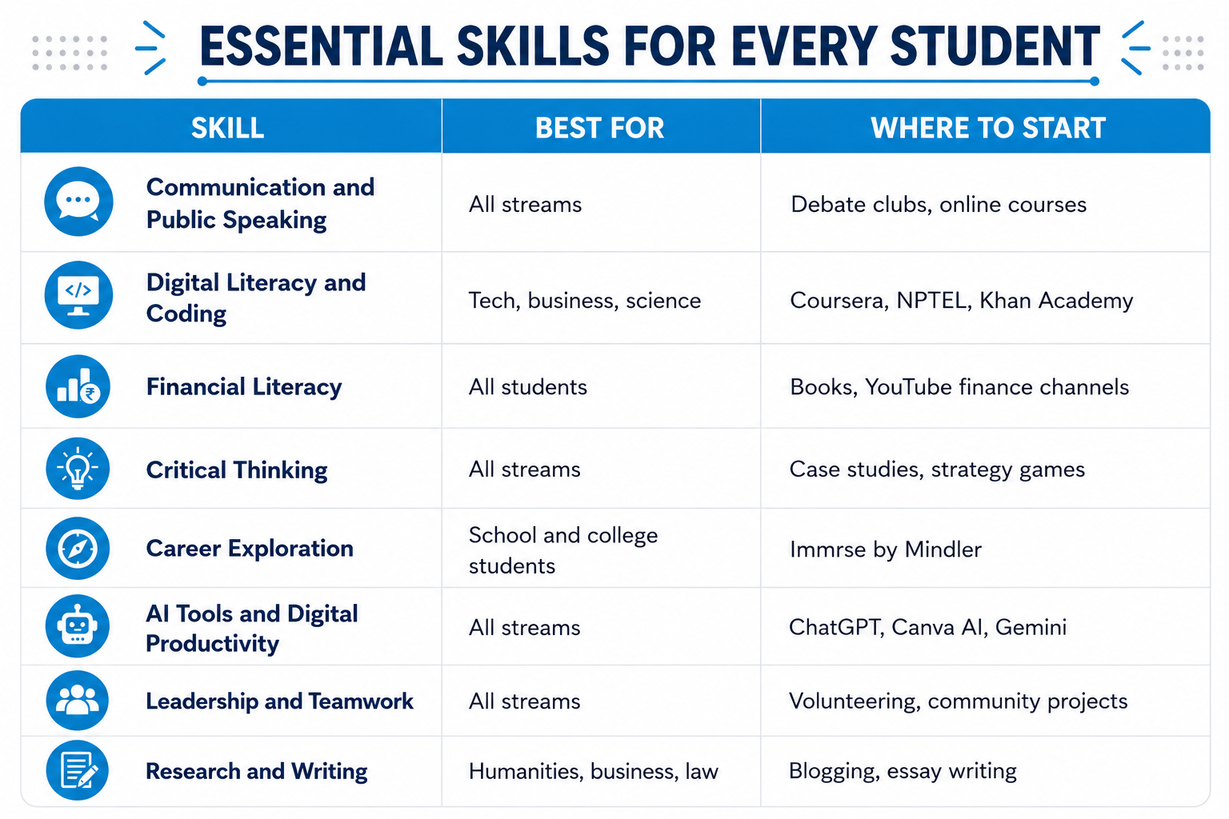
8 Top Skills to Learn During Summer Vacation for Students
Here is a practical list of skills to learn in vacation for students across different interest areas. You do not need to learn all of them. Pick two or three that align with where you want to go.
- Communication and Public Speaking
Most students underestimate how much communication matters until they are sitting in an interview, a group discussion, or a college presentation and realise that knowing the answer is not enough. Expressing it clearly is what actually gets noticed.
Communication is the one skill that cuts across every career. Engineers present ideas to clients. Doctors explain diagnoses to patients. Designers defend their work to stakeholders. Entrepreneurs pitch their vision to investors. In every professional setting, the person who communicates well consistently gets further than the one who simply knows more.
Use this summer to join a debate group, take a public speaking course, or practise writing regularly on a topic you follow closely. The goal is to build the habit of expressing your thoughts with clarity, both out loud and in writing, before the pressure of real situations demands it.
- Digital Literacy and Basic Coding
You do not need to become a software engineer to benefit from knowing how to code. Basic programming in Python, understanding how data works, or even mastering Excel formulas, puts you ahead in almost every field, technical or not.
A marketing student who understands basic automation has an edge over one who does not. A finance student who can work with data in Python moves faster than one relying entirely on spreadsheets. A journalism student who understands how websites are built writes better digital content. Digital literacy is no longer a technical skill. It is a professional one.
Platforms like Khan Academy, Coursera, and NPTEL offer free beginner courses that are easy to follow during vacation. This is one of the most sought-after skills to learn in vacation for students right now, regardless of stream.
- Financial Literacy
Most Indian students reach adulthood without understanding how money actually works. Budgeting, saving, understanding taxes, and knowing the basics of investing are life skills that no school teaches properly.
Spend a few hours this summer reading about personal finance. Books like Let’s Talk Money by Monika Halan are a good starting point for Indian students specifically.
- Critical Thinking and Problem Solving
Employers consistently rank critical thinking as one of the most valued skills in a candidate, yet it is rarely taught directly in school. Most academic environments reward memorisation and correct answers. Critical thinking requires something different: the ability to question assumptions, evaluate evidence, and arrive at a reasoned conclusion.
There are practical ways to build this skill during the summer. Working through case studies from business or public policy teaches you to analyse problems with incomplete information. Reading books like Thinking, Fast and Slow by Daniel Kahneman or Freakonomics by Steven Levitt trains the mind to look for patterns and challenge surface-level explanations. Strategy-based games like chess or simulation exercises develop the habit of thinking several steps ahead before making a decision.
These are not activities that feel like studying. But the cognitive habits they build show up clearly in interviews, college entrance tests, and professional environments. For a broader look at abilities worth developing early, read this article on essential life skills for school students.
- Career Exploration and Self-Awareness
One of the most valuable things you can do this summer is figure out what actually interests you. Most students pick streams or courses based on pressure, not passion.
Summer ideas for students around career exploration include:
- Taking a career assessment test
- Talking to professionals in fields you are curious about
- Doing a short virtual internship or shadowing programme
- Exploring platforms like Immrse by Mindler that offer structured virtual career internship experiences designed specifically for school and college students in India
Understanding yourself early shapes every decision you make going forward.
- AI Tools and Digital Productivity
AI is not a future trend. It is already part of how work gets done across every industry, from healthcare and finance to design and education. Students who know how to use these tools effectively are not just more productive. They are more prepared for the professional environments they are about to enter.
Consider a commerce student who uses AI tools to summarise financial reports, generate draft analyses, and create presentation decks in half the time. Or a humanities student who uses AI to organise research, check arguments, and refine writing before submission. The skill is not in the technology itself. It is in knowing how to direct it purposefully.
You do not need a technical background to get started. Most AI tools are built to be beginner-friendly and can be applied to academic work immediately. Read more about building an AI-ready career to understand what skills will matter most in the next few years.
- Leadership and Teamwork
These are skills you build through doing, not reading. Organise a community project, volunteer with an NGO, start a small initiative in your neighbourhood, or take up a team role in a summer programme.
Leadership is not about managing people. It is about taking initiative and seeing things through. That habit, built early, stays with you throughout your career.
- Research and Writing
The ability to find reliable information, analyse it, and present it clearly is useful in every field. Start a blog, write short essays on topics you find interesting, or practise summarising articles and books.
Strong writing is still one of the rarest skills among students. It is also one of the most noticed by college admissions teams and employers alike. Beyond placements and interviews, it directly shapes the quality of your Statement of Purpose, Letters of Recommendation, scholarship applications, and every other document that represents you on paper when you are not in the room.
What Should You Actually Pick This Summer?
You do not need to do all eight. Trying to learn everything at once usually means learning nothing properly. Think about what you want from the next two years. Is it a strong college application? A clearer sense of direction? A skill that helps you earn during college? Start there.
If career clarity is what you need most, a structured virtual internship programme is one of the smartest summer ideas for students. Platforms like Immrse by Mindler connect students with real industry exposure through virtual career internships, helping you understand what different professions actually look like before you commit to a path.
Understanding the future of work and education also helps you make better decisions about what to prioritise right now.
Key Takeaway
Summer vacation is not a gap in your academic calendar. It is an opportunity that most students let go of without realising its value.
What skills should I learn in summer vacation? The honest answer depends on where you are headed. But whatever direction that is, starting early, staying consistent, and choosing skills that genuinely interest you will always take you further than last-minute preparation. Use this summer well. The next version of you will thank you for it.
FAQs
- How much time per day is ideal for developing these skills over the summer months?
Even an hour or two a day would suffice. The most critical element is consistency rather than the number of hours spent per day.
- Can school students in classes 8th and 9th begin developing these skills?
Definitely. In fact, starting the process in Classes 8th and 9th would give your child ample time to experiment and make adjustments to their path.
- Does the development of these skills influence college admission prospects?
Absolutely. Universities, particularly competitive programs, go beyond the marks scored. They value certification, internship experience, and skill development.
- Do parents have to incur expenses for taking courses on developing these skills?
In no way. You can start most of these skill development processes without spending any money through platforms such as Coursera, Khan Academy, YouTube, and NPTEL.
- How will parents understand which skill is the correct one for their child?
One way to begin is by conducting a career assessment that matches the skills and aptitudes of your child with potential career options.