India is projected to have the world’s largest working-age population by 2030, with over 1 billion people between the ages of 15 and 64. A decade ago, most of those young people were choosing from the same short list of careers: engineering, medicine, finance, or a government job. Today, that list looks nothing like it used to.
A decade ago, there were only a few career options available to students, mainly engineering, medicine, finance, or government employment. The situation today is much different. The rapid rate of digitalisation, birth of new industries, and continuous innovations have led to many new job opportunities which never existed ten years ago.
Career preferences have differed across various generations. The generation of millennials was mostly focused on employment security, financial stability, and career development. Gen Z, in turn, is more flexible, purpose-driven, creative, and skill-focused.
Such changing tastes are transforming the way that students consider career choices and map their career paths in a world that is becoming more dynamic and uncertain.
Why Career Choices Have Changed
The modern world has no more restriction in career choice based on traditional careers. Remote work, globalisation, and technology have greatly augmented the opportunities that students have.
A decade ago, the standard career options list for most Indian students looked the same across households: engineering, medicine, law, banking, or a government job. These were considered safe, respectable, and financially stable. Anything outside this list was either discouraged or simply unknown.
Today, that list has expanded far beyond what most parents and students could have imagined. The previous generations are willing to have jobs that were secure in terms of economics and social aspects. Academic qualifications have ceased to be essential in sectors such as creativity, flexibility, and expertise.
In all parts of the world, the best-paid and most demanded jobs are:
- Data Science
- UX/UI Design
- Content Strategy
- Cybersecurity
- Climate Technology
- Machine Learning and AI
- Sports Analytics
- Game Design
- Influencer Marketing
LinkedIn’s Future of Work report also highlights that digital and technology-based roles are among the fastest-growing professions worldwide. The above discussion clearly brings out the significance of moving past the aspect of job security to consider factors such as adaptability, skill building, and career advancement.
For example, Nikhil, who is 24 years old and comes from Pune. He started as a mechanical engineering student, discovered a passion for data visualisation during an internship, and today works as a data storyteller for a product company in Bengaluru. His job title did not exist when he started college. His career was not planned. It came into existence out of curiosity and the urge to expand beyond the conventional choices.
Millennial Career Trends vs Gen Z Career Trends
The outlook towards careers of both millennials and Gen Z is entirely contrasting owing to their distinct social and technological surroundings.
Millennials joined the workforce amid high economic growth and were largely concerned with job security, education, and success in the corporate sector. Generation Z emerged in an era where technology was dominant and was characterized by a significant concern for flexibility and creativity.
This is a revised comparison without using the original chart and replacing it with a new Gen Z vs Millennials comparison:
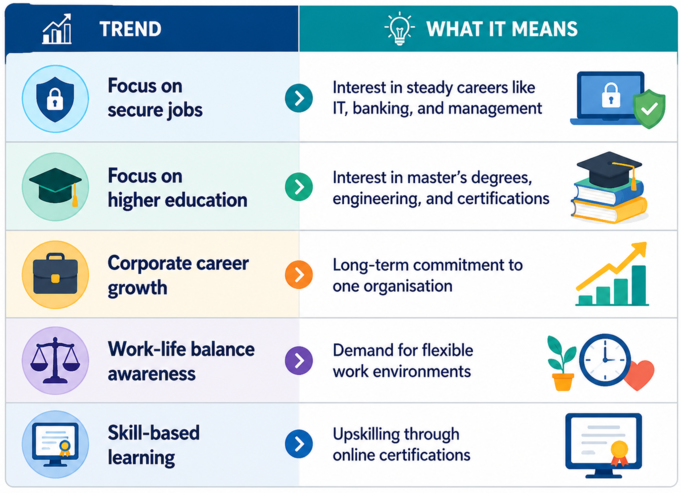
Recent Deloitte research, “On-the-job learning drives career growth for 94% of Gen Zs, 97% of Millennials in India,” found that over 90% of Gen Z professionals actively focus on skill-building opportunities while choosing jobs. Also, many young professionals are fond of companies that value their mental well-being and offer flexibility and opportunities for changing jobs and advancing in careers.
What Defines Gen Z Career Trends?
The work trends among Generation Z align with the shifting workplace trends and increasing focus on self-improvement, flexibility, and meaning. Unlike earlier generations, where stable job security was desirable, Gen Z students and employees mostly strive to join careers where they can always keep learning, explore various opportunities, and achieve harmony in their work and personal lives.
Key factors that shape the current Gen Z career trends include the following one:
- Meaningful and inspirational occupations.
- Being freelancers and entrepreneurs.
- Careers in digital technologies.
- Flexible work environments.
- Life-long learning and skill improvement.
Many students today prefer exploring a variety of career options instead of committing to a single career path throughout their lives.
The Best Career Options in 2026
With the development of industries, some of the career options are likely to increase at a higher rate compared to others. The optimal career opportunities are always guided by interests, aptitude, personality, and future aspirations.
The following are the best future career opportunities for students:
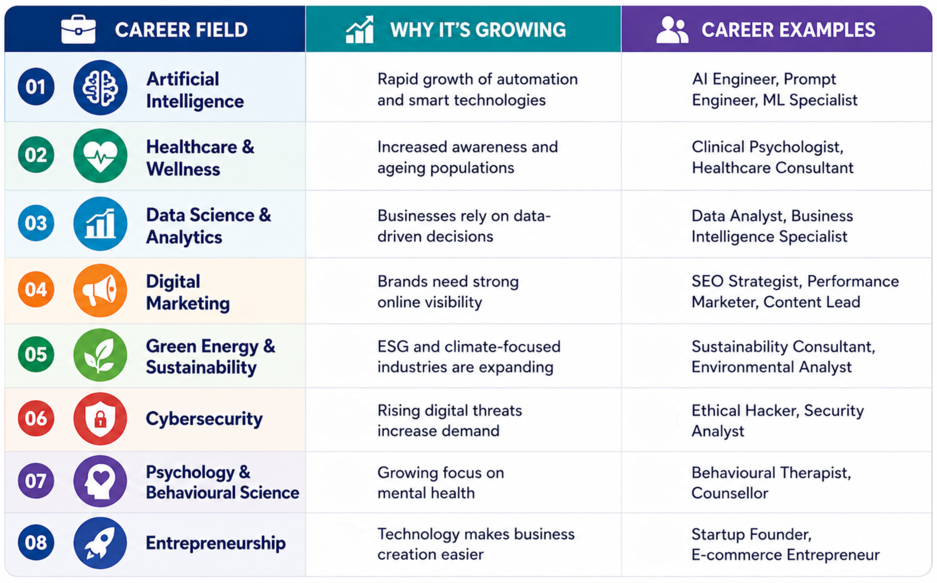
According to the World Economic Forum, sectors like artificial intelligence, data analytics, sustainability, and cybersecurity are expected to have some of the highest rates of growth across the world in the next decade.
How to Explore All Career Options
Having numerous career choices at present, students are often at a loss as to what to start with. The process of career selection can be a lot easier and more successful with a structured approach.
- Discover Your Strengths and Passions: The first step involves identifying what areas you like to learn about and solve problems related to and in which work environment do you thrive.
- Take a Career Assessment Test: It assesses different aspects of your personality, your aptitudes, your interests, and your motivations, thus helping you limit the choices available to you to those that are really relevant to you.
- Research Industry Trends: Look at salary potential, job demand, growth prospects, and required qualifications before committing to a path. This helps you prepare for future career options with clarity.
- Seek Advice from a Career Advisor: It helps you relate your unique set of skills to viable career options and plan accordingly.
- Get Exposed: Gaining practical experience through internships and workshops enables you to gain firsthand insights into various industries.
Common Career Mistakes
Most of the students make career choices depending on the outside forces rather than their own aptitude and future aspirations.
The following are pitfalls to avoid:
- Career choice on a salary basis.
- Following friends blindly.
- Being unselfish.
- Selecting careers on the basis of prestige.
- Failure to consider the future trends in the industry.
- Failure to take professional career guidance.
Gallup State of the Global Workplace Report revealed that almost 6 out of 10 workers in the world are emotionally disengaged in the work environment, with an estimated 19% stating that they are unhappy in their professions.
This data highlights that the popularity of a profession does not necessarily guarantee long-term satisfaction or fulfilment.
Why Parents Need to Understand Modern Careers
For most parents, career advice comes from personal experience built in a different economy and a different job market. That experience, while valuable, does not always apply to the world students are entering today.
Here is why staying informed matters:
- The careers offering the strongest growth today, such as data science, UX design, cybersecurity, and climate technology, did not exist in any meaningful form a generation ago.
- A parent unfamiliar with these fields may unintentionally discourage a child from a path that genuinely suits them.
- Family influence remains one of the strongest factors in career decision-making among young Indians.
- Parental involvement does not need to mean directing choices. It can mean asking better questions, staying curious about emerging industries, and supporting exploration rather than narrowing it.
- The influence of family is considered as one of the most important elements affecting career decisions made by young Indians.
It is not necessary for parents to direct their children towards a specific path. Rather, they may ask more questions and be curious about new fields that emerge.
Why Career Counselling Matters Today
Career counselling assists you in making quality decisions with regard to your career in a changing world. A career coach will assist you:
- Find your strengths and interests.
- Explore suitable industries
- Build career roadmaps
- Plan educational pathways
- Get ready for the changes in the industry.
Career counselling becomes even more relevant since there is continuous change taking place in all industries owing to AI and automation, and students can easily explore their career paths.
Key Takeaway
Your choice of career not only defines your professional trajectory but is also essential for your personal growth and satisfaction. With the modern world being a dynamic environment, traditional ways of selecting careers are not necessarily your only option anymore. Exploring your career can be both thrilling and challenging due to the countless new possibilities that emerge all the time.
At Mindler, you can access personalised career counselling, psychometric assessments, and expert guidance to discover career paths that truly align with your goals and aspirations.
FAQs
1) When does a student need to start considering his/her career?
Exploring the career possibilities of a student can start as early as the eighth or ninth class. This would give him/her enough time to understand his interests, evaluate options and choose subjects that will help him in making decisions regarding further studies in class eleven.
2) Is career counseling beneficial even when a student knows his career interests well?
Yes, in such cases too, career counseling plays a very important role. Not only does it affirm his choice but also identifies the appropriate course for him and highlights the gaps if any, in his preparation for the same.
3) How do psychometric tests aid in selecting a suitable career option?
Psychometric tests are conducted in order to assess the personality of an individual, his/her aptitude and interest. Based on the results obtained, suitable careers where he/she may succeed are identified.
4) Is it possible to change careers at a later point of time after having taken up a particular stream initially?
Yes, There are a lot of professionals who now have nothing to do with the streams that they opted for originally during college years.
5) What is the role of extracurricular activities in shaping career choices?
Extracurricular activities often reveal strengths and interests that academic performance does not. An individual who leads the debate team at their high school, or organizes events and builds applications as a hobby is already exhibiting career-worthy traits and should be acknowledged.