Career guidance today involves more than just helping students select a career. Parents and students, as well as professionals in the workforce, are seeking more help from career coaches with decisions about education and career change, and career development. As the role of career advice becomes increasingly prominent in an individual’s future, it is essential that career coaching is ethical, responsible, and professionally conducted.
Career coaches have access to confidential information about personality, interests, abilities, aspirations, and goals. So, ethics are important to make sure career advice is objective, confidential, and always in the client’s best interests. The NCDA Code of Ethics can assist with this.
This code, as developed by the National Career Development Association (NCDA) can help career professionals to stay professional, ethical, and credible while offering responsible career advice.
The Significance of Ethics in Career Coaching
Career coaching has a direct influence on educational and professional decision-making. Making ethical behaviour one of the most significant parts of the profession, students tend to seek the counsellor’s assistance in uncertain life periods.
Lack of professional ethical standards may make counselling practices biased, commercially motivated, or misleading. Ethical career coaching makes the career guidance objective and in the best interests of the student in the long-term.
Ethical career coaching generally involves:
- Maintaining confidentiality
- Providing unbiased recommendations
- Respecting individual differences
- Using scientifically validated assessments
- Avoiding conflicts of interest
- Delivering accurate career information
The State of the Global Workplace Report by Gallup demonstrates that just 23% of workers all over the globe are engaged at work, which is why career guidance being personally matched to individuals, their interests, and long-term satisfaction with career options is gaining increasing importance.
Another similarity in the ethical practice of counselling highlighted by the National Career Development Association is that ethical counseling practices enhance client trust and elevate the quality of career guidance products.
Understanding the NCDA Code of Ethics
The NCDA Code of Ethics refers to the professional ethical framework developed by the National Career Development Association for career development professionals.
The framework outlines standards that guide professionals while working with students, parents, institutions, and organisations. These standards apply across both offline and online career counselling environments.
The NCDA code of ethics covers several areas, including:
- Professional relationships
- Confidentiality and privacy
- Ethical use of assessments
- Multicultural competence
- Technology and online counseling
- Career information and communication
- Professional responsibility
These guidelines ensure that career coaching practices remain ethical, transparent, and student-focused.
Core Principles of the NCDA Guidelines
The NCDA ethical framework is based on a set of professional principles that help counsellors maintain ethical standards in their practice.
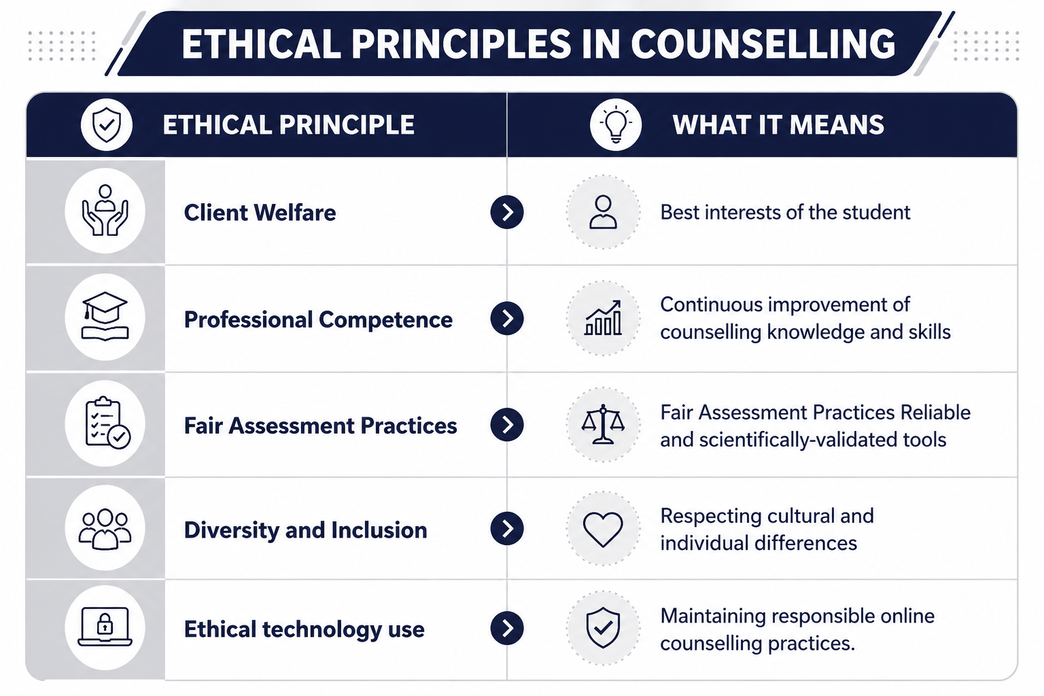
These values aid in setting the principles of professional accountability and promoting the trust between counsellors and students.
Career Counseling Competencies at NCDA
The NCDA also outlines professional competencies necessary to practice effective career counselling as well as ethical standards. The NCDA career counseling competencies outline the knowledge and practical skills career professionals should possess.
These competencies include:
- Career development theories
- Counselling and communication skills
- Assessment interpretation
- Labour market awareness
- Ethical and legal understanding
- Multicultural counseling competence
- Technology integration in counselling
As industries continue to evolve because of automation and digital transformation, career professionals are also expected to continuously upgrade their competencies.
LinkedIn’s Workplace Learning Report found that 89% of learning and development professionals believe proactive skill-building is essential for navigating the evolving job market. It is clear why career counselors need to consistently improve their competence in counselling and in-depth knowledge of the industries.
Why Ethical Standards are Becoming More Important
With the rise in popularity of online counseling, use of artificial intelligence tools for assessment, and virtual career coaching applications, ethical standards have become more important in career counseling.
Students disclose very personal data in their counseling sessions, such as:
- Academic records
- Assessment reports
- Personality insights
- Career concerns
- Personal aspirations
There is also an increase in untrained or uncertified career coaches due to the increasing need for career guidance. These kinds of standards could also be used in distinguishing between professional career coaches and unprofessional and unethical career coaching practices.
The Future of Jobs Report 2025 from World Economic Forum indicates that almost 44% of the key skills possessed by the workforce are likely to undergo drastic changes in the next five years owing to the technological disruption and automation process. This phenomenon has resulted in an increased need for ethical career guides who would assist students in navigating rapidly changing industries.
How Career Coaches Apply Ethical Standards in Real Situations
Professional ethics are more than just theory. Here’s how ethical career coaches act in these practical situations:
- When the parent wishes the child should pursue a specific career path against his or her wishes: The career coach does not succumb to external pressure and continues to concentrate on the interests of the child and analytical data rather than succumbing to external pressure and helping to make a reasonable decision.
- When there is a surprising outcome to a psychometric test: The coach will clearly explain the results of the test, placing them within the context of the overall profile and taking them only as one factor among others.
- When confidential information about the client is revealed: Regardless of who the information seeker is, the coach will always respect strict confidentiality when providing guidance. All information is to be used to assist clients in their career building.
- When a student wants to know more about a particular professional area the coach has little knowledge about: Instead of giving incorrect recommendations, the coach should refer the student to other professionals and conduct additional research on the issue.
- When students follow their peers’ decisions instead of focusing on their strengths: The coach needs to shift focus back to their skills and interests.
These scenarios reflect why structured training and adherence to professional ethical frameworks are foundational to credible career coaching, not optional additions.
Topical Ethical Dilemmas in Career Coaching
Working with students, their parents, and educational institutions, career counsellors might face a number of ethical dilemmas.
Some commonly observed challenges include:
- Parental pressure influencing student decisions
- Biased career recommendations
- Misinterpretation of psychometric assessments
- Breach of confidentiality
- Promotion of careers based only on financial outcomes
- Limited awareness of emerging career fields
Professional ethics assist counsellors to approach such circumstances with impartiality, fairness, and a student-centred focus. The difference between a trained career coach and an unregulated one often becomes most visible in exactly these moments.
Consider a Class 12 student whose psychometric profile points strongly toward design, but whose parents are pushing for engineering. An ethically prepared coach uses objective assessment results, helps establish an informed discussion, and makes sure that the final course of action takes into account the student’s strengths rather than any outside influence.
The NCDA Code of Ethics clearly outlines the requirement for career professionals to treat their clients with due dignity and serve their well-being, regardless of the wishes of parents or other financial incentives.
Certified coaches who hold such certifications as NCDA Certified Career Counsellor or ICCC Advanced Certification by Mindler are professionally trained to deal with such dilemmas according to ethical principles, not on a personal basis. In a field with no mandatory regulatory standard in India, certification remains the clearest differentiator between qualified practice and unregulated advice.
Moral Uses of Career Tests
Psychometric tests have become part of contemporary career counseling, and ethical interpretation and responsible usage are just as crucial.
Career coaches are expected to:
- Use scientifically validated assessment tools
- Explain results clearly and responsibly
- Avoid stereotyping students
- Combine assessment results with counseling discussions
- Maintain confidentiality of reports
The NCDA code of ethics strongly emphasises the responsible use of assessments to ensure balanced and realistic career guidance.
Ethics in Online Career Counselling
Technological advancements have seen the availability of career guidance services through digital media increase immensely. Online counseling and assessments, together with career counseling by artificial intelligence, have improved accessibility.
But online counseling also raises ethical issues around:
- Data privacy
- Digital consent
- Confidential communication
- AI bias
- Secure technology platforms
According to the NCDA Code of Ethics, career professionals are supposed to have similar standards for online and offline career services.
Recent research by Deloitte indicates that 94 percent of Gen Z professionals and 97 percent of millennials in India regard lifelong learning and skill enhancement essential to a successful career. It was also indicated that a considerable number of young professionals prefer workplaces offering flexibility, good health and career mobility.
Why Professional Training Matters in Career Coaching
Professional training can assist career coaches not only to build structured counseling techniques but also to learn ethics and career development.
Formal training programmes generally help professionals strengthen:
- Counselling techniques
- Ethical practice frameworks
- Assessment interpretation
- Career planning strategies
- Communication and listening skills
With the ever-growing career coaching industry worldwide, the structured certification programmes are proving worthwhile in ensuring that the profession is upheld. The international coaching market is also experiencing steady growth with an influx of students and professionals in search of structured career advice and qualified coaching services.
Mindler also offers ICCC Advanced Certification to professionals who are interested in training in career coaching on an advanced level.
Learning About the NCDA Code of Ethics APA Citation
When doing their academic projects on counseling and career development, students and researchers tend to look up the NCDA code of ethics and APA citation.
However, citation formats may vary depending on institutional requirements and updated editions of the document.
Key Takeaway
The students and families who seek career guidance are making some of the most consequential decisions of their lives. They deserve advice that is objective, informed, and free from commercial or external bias. That standard does not happen by default. It requires systematic training, alignment with the profession’s ethical guidelines, and dedication to the best interests of the client over the long term.
The NCDA Code of Ethics and career counselling competencies were developed specifically to uphold this code of conduct. This means that any discussion between a career coach and a student will be based on transparency, confidentiality, and research-supported suggestions.
With increasing numbers of people turning to career coaching in India, it is becoming increasingly important to distinguish between certified professionals and unethical coaches who practice without credentials. Choosing the right platform or counsellor becomes critical to receiving advice that is in the best interests of the student.
The career counselling services provided by Mindler are conducted by professionals who adhere to ethical codes. They provide a combination of psychometric evaluations and industry knowledge to assist students with making decisions at all stages of their educational and career development.
FAQs
1) What are the benefits of having an ethical career coaching?
Ethical career coaching helps students make unbiased career decisions and also makes sure that the students maintain their career goals, interests, and confidentiality.
2) Why is it important to have confidentiality when doing career counseling?
Confidentiality allows for building a relationship of trust between the counsellor and the student allowing the client to disclose his/her confidential information about his or her worries and hopes as well as any problems he or she might be experiencing.
3) How can ethical considerations affect the process of career selection?
Ethical considerations can ensure that the career counseling becomes student-centered, ethical, and effective thus ensuring that there is a good match between the chosen careers and student interests and skills.
4) What standards do the NCDA apply while performing online career counseling?
The NCDA has several standards for conducting online career counselling including confidentiality, privacy, informed consent, and online communication.
5) Why should career coaches get professionally certified?
Professionally certification assists career coaches to develop their counseling skills and ethics, assessment skills interpretation and to get familiar with current industry trends.