
Finances is a profitable and lucrative profession that one can choose to pursue in India. The field of finances is key when it comes to development, innovations, and transformation, regardless of whether the field is investment banking, technology of finance, taxation, or corporate strategy. However, as for the finance students planning for their future, a major dilemma still arises; which should be preferred between CA and CFA?
Some find the security and fame associated with Chartered Accountancy more attractive. Others are interested in the investment analysis, portfolio management, and worldwide finance jobs that accompany the Chartered Financial Analyst (CFA) designation. The fact says that CA and CFA are dissimilar. It is not the same course, job and skills.
If you wish to know the difference between CA and CFA, this guide explains the eligibility, syllabus, career prospects, salary, and difficulty of the two courses.
Understanding CA and CFA
Chartered Accountancy (CA) is a professional qualification regulated by the Institute of Chartered Accountants of India (ICAI). It focuses heavily on:
- Accounting
- Taxation
- Auditing
- Corporate law
- Financial reporting
- Compliance
CA professionals are usually associated with auditing firms, taxation consultancy, corporate finance departments, and business advisory services.
Chartered Financial Analyst (CFA) is a globally recognised certification offered by the CFA Institute, USA. It specialises in:
- Investment analysis
- Portfolio management
- Equity research
- Financial modelling
- Wealth management
- Risk analysis
CFA is especially popular among students who are interested in investment banking, asset management, and global finance careers.
Thus, when students inquire if CA and CFA are the same, the answer is no. They are both related to finance, but are two very different professions.
CA vs CFA: Key Differences
To be able to grasp what is the difference between CA and CFA courses in India, here’s a simplified comparison table:
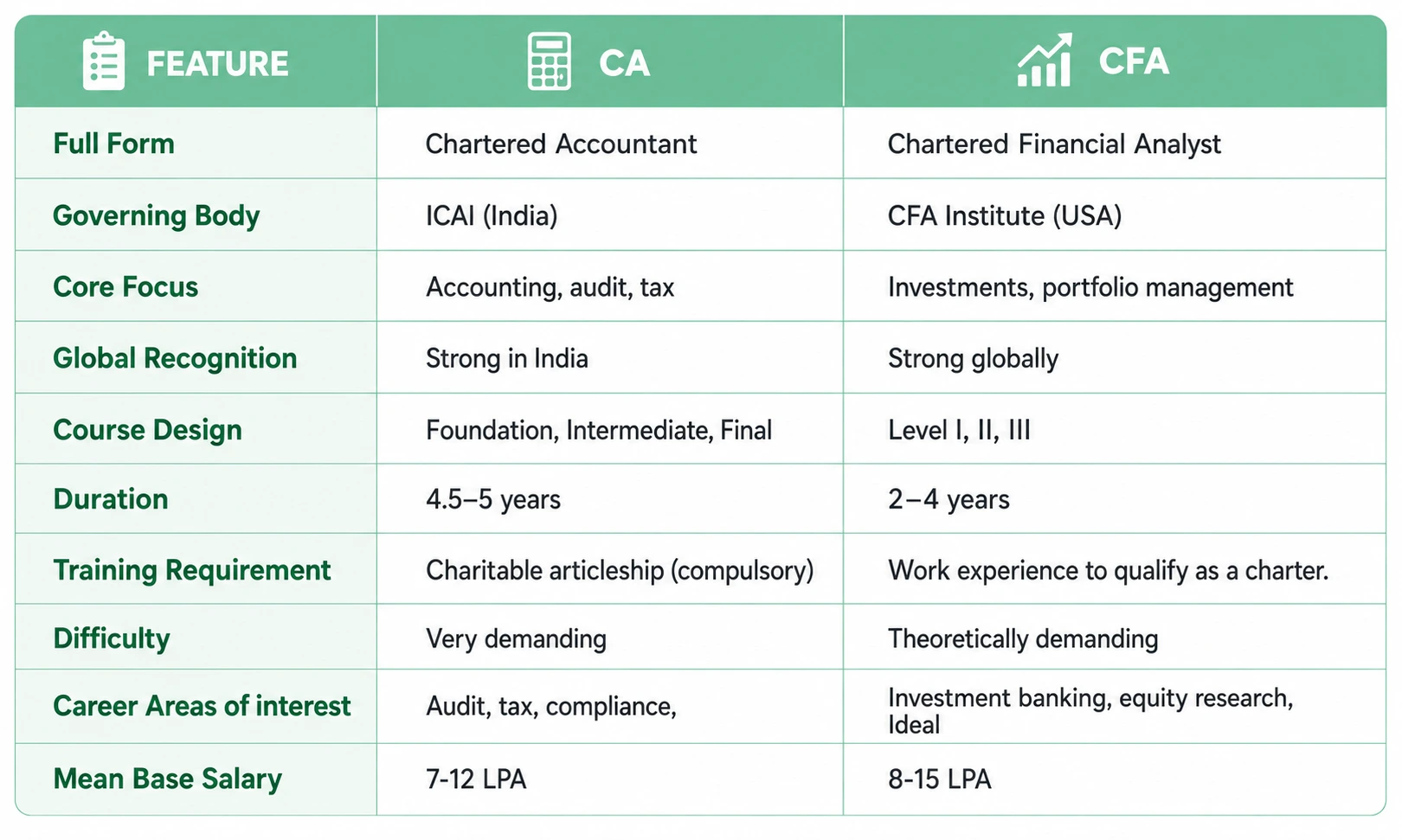
Which is Tough: CA vs CFA?
One of the most googled questions is CA vs CFA, which is tough. This is subjective and depends on your interests.
CA is known for:
- Vast syllabus
- Intensive theoretical learning
- Strict passing criteria
- Long preparation cycles
- Articleship alongside studies
ICAI data shows pass rates in CA Final exams to be less than 20%. Students must be disciplined, consistent, and patient to complete the course successfully.
Even though there may be no articleship in CFA, the course is academically challenging because of:
- Deep analytical concepts
- Quantitative finance
- Investment valuation
- Global financial standards
According to the CFA Institute, the average study time for each level is 300+ hours.
So, when it comes to CA vs. CFA difficulty, CA is considered to be more operational and more comprehensive, whereas CFA is more specialised and analytical.
CA vs CFA Syllabus
The next big consideration in CA vs. CFA is the syllabus.
- CA Syllabus Includes:
- Financial accounting
- Cost accounting
- Taxation
- Auditing
- Corporate laws
- Strategic financial management
CFA Syllabus Includes:
- Ethics and professional standards
- Economics
- Equity investments
- Fixed income
- Portfolio management
- Alternative investments
- Financial reporting and analysis
Typically, students with an interest in markets, investments, and analytics prefer CFA, whereas students with an interest in accounting systems and compliance prefer CA.
CA vs CFA Salary in India
There is a lot of interest in who earns more, CA or CFA.
The fact is that the salary depends on skills, experience, industry, city and employer reputation. But both degrees can offer high salaries.
Average CA Salary in India for freshers ranges between ₹6–13 LPA in audit firms and corporates.
Higher packages can be expected in consulting and international firms. Experienced CAs in leadership positions can earn significantly more.
An average CFA Salary in India ranges between ₹8–15 LPA for early-career roles. Much higher compensation can be expected in investment banking and portfolio management
CFA candidates and charterholders often work in:
- Investment banking
- Asset management
- Equity research
- Wealth management
According to CFA Institute compensation insights, CFA charterholders globally often receive salary premiums due to specialised expertise.
So, in the case of CA vs. CFA salary, neither of the qualifications is sure to earn higher income. The future of a career relies on career fit and industry demand.
CFA for CA Students: Is It Worth It?
Many commerce students now explore CFA for CA students because the combination is becoming increasingly valuable.
A CA already possesses experience in:
- Accounting
- Taxation
- Corporate finance
Adding CFA brings:
- Investment knowledge
- Financial analysis
- Portfolio management skills
These are skills that are useful, especially in investment banking, corporate finance, mergers and acquisitions, financial consulting, and fintech.
CA vs CFA in India: Which is Better?
The question is, is it better to be a CA or a CFA in India? The answer depends entirely on your career aspirations.
CA May Be Better If You:
- Enjoy accounting and taxation
- Want a stable corporate finance career
- Are interested in auditing and compliance
- Prefer structured finance roles in India
CFA May Be Better If You:
- Enjoy financial markets and investments
- Want international finance exposure
- Like analytics and valuation
- Aspire to work in investment banking or wealth management
- A Smart Combination
Increasingly, students are combining finance qualifications with digital and analytical skills because finance itself is evolving rapidly.
The World Economic Forum identifies artificial intelligence (AI), big data, cybersecurity, and technological literacy as the jobs of the future. This is why financial positions today also require analytical skills – finance and data analytics.
How to Choose CA or CFA
Trends are not everything when choosing careers. What works for others might not work for you.
When deciding on the superior one, between CA and CFA in India, put into consideration:
- Your interest areas.
- Familiarity with quantitative topics.
- Career lifestyle expectations.
- Long-term goals.
- Analytical/ compliance skills.
In case you are still at a crossroads, then you can visit a career counsellor in order to find out the most suitable one to your career with regard to your skills and interests.
Key Takeaway
CA and CFA are both prestigious but very different qualifications. CA focuses on accounting, audit, taxation, and compliance. Investment management and financial analysis are among the areas where CFA specializes.
In the case of comparing CA and CFA for difficulty, each is tough but differently. Income levels may be more influenced by skill sets and industries than the qualification alone. The combination of CA and CFA can lead to great prospects for today’s finance careers.
At Mindler, students are encouraged to evaluate career choices based on aptitude, interests, and long-term aspirations rather than only salary trends.
FAQs
1) Can we do CFA and CA together?
CFA has a lot of commonality with CA, particularly post the CA Inter examination, as there are some subjects that are commonly shared, such as financial accounting or corporate finance. These can be utilized to develop a portfolio in finance.
2) Will CFA aid in securing a job abroad?
Yes. CFA has popularity and repute in the USA, UK, Canada, Singapore, and UAE, and CFA could potentially improve your chances in getting jobs in the field of investment banking or wealth management.
3) CFA vs CA – which one would be better for an investment banking career?
You can secure investment banking jobs with both the certifications, however, CFA candidates are better suited for analysis, valuation, and portfolio management. But CAs with financial modeling expertise are very sought after.
4) In which context is each type of certification more relevant today?
The CFA is better placed when it comes to fintech jobs and investments, while data sciences also find the CFA more relevant. But even CAs who have experience in fintech and analytics are in greater demand.
5) Are science students able to pursue CA and CFA?
Yes, all streams can opt for CFA post their graduation, and similarly, science streams can pursue CA post-Class XII if they wish to take up commerce and finance.