Introduction
The CBSE’s ‘Counsellor & Wellness Teacher’ rules have changed significantly in 2026. The provision regarding counsellors in the CBSE affiliated schools is now more comprehensive, covering both the Counselling & Wellness Teacher (Socio-Emotional Counsellor) and Career Counsellor.
Therefore, it becomes important for the schools to need to know about the rules for hiring experts for these positions as it will help them deal with the growing needs and complexities of helping students with their education and career plans.
If you are a school principal, administrator, educator, or a professional working with schools or planning to do so, this guide explains what the updated CBSE guidelines mean, who can take up these roles, what qualifications and competencies are required, and how trained career professionals can contribute to effective career guidance within schools.
What Has Changed in the CBSE Counsellor and Wellness Teacher Rules?
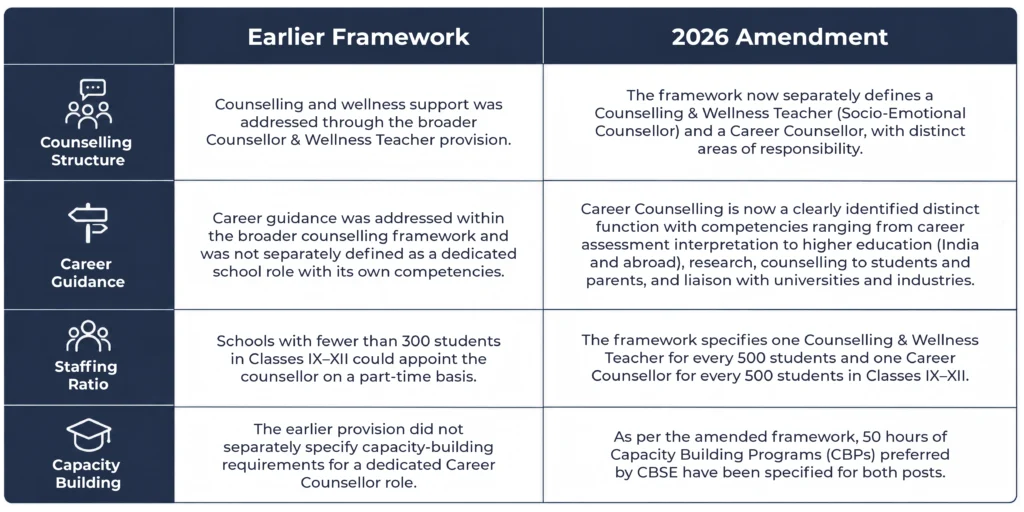
The previous CBSE framework mandated Secondary and Senior Secondary schools to appoint a counsellor & wellness teacher and required them to have qualifications in Psychology, Child development and Career guidance and counseling. The schools with student strength of less than 300 students in classes IX-XII had the option to appoint the counsellor & wellness teacher on part-time basis.
The amended CBSE policy for 2026 makes a distinction between the roles of Counselling & Wellness Teacher (Socio-Emotional Counsellor) and Career Counsellor. They both have different roles and competencies to be fulfilled.
Counselling & Wellness Teacher vs Career Counsellor: What’s the Difference?
The two roles support different aspects of student development.
Counselling & Wellness Teacher
The Counselling & Wellness Teacher, also referred to as a Socio-Emotional Counsellor, focuses on students’ social, emotional and psychological wellbeing.
The specified competency areas include:
- Social and Emotional Learning (SEL)-
- Crisis intervention
- Identification of mental health concerns
- Parent and teacher sensitisation –
- Confidentiality
Career Counsellor
The Career Counsellor focuses on students’ education and career-related decisions.
The specified competencies include:
- Career assessment interpretation
- Indian and global higher education landscape
- Research skills
- Student and parent career counselling
- Collaboration with universities and industry
The difference is crucial as career planning needs to be approached differently than socio-emotional counselling. A student may require both services depending on their educational and personal circumstances at a particular stage of their school life.
Who Can Become a CBSE Counsellor?
According to the 2026 provisions, a career counsellor must have a graduate or postgraduate degree in:
- Humanities
- Science
- Social Sciences
- Management
- Education
- Technology
The eligibility criteria also require career counsellors to have an understanding of career assessment interpretation, higher education, research, counselling, and collaboration with universities and employers.
On the other hand, the provisions describe different qualifications for Counselling & Wellness Teacher. A counsellor can qualify for this category by having a graduate or postgraduate degree in Psychology, a postgraduate degree in Social Work with an emphasis on Mental Health or Counselling, or a degree in any discipline and a Diploma in School Counselling or Child Guidance and Counselling.
Both roles also include a 50-hour Capacity Building Programs (CBPs) preferred by CBSE in their respective areas.
What Does This Mean for Schools?
The revised framework provides schools with more clarity on career guidance that could be provided to students as part of the student support system. With a 1:500 ratio for Career Counsellors for Classes IX–XII, schools must now think through the requirements in terms of headcount and competence for career guidance.
In case if the school does not have a career counsellor, the school can nominate one of the teachers, who would need to acquire the right qualifications and skills within 2 years.In other words, schools can take up the responsibility of strengthening their teaching staff with career counselling competencies, so as to provide that support to students.
For schools, the focus therefore extends beyond appointing a professional. It is also about ensuring that the person providing career guidance has the appropriate knowledge, skills and preparation to support students effectively.
What Do the CBSE Changes Mean for Career Professionals Practicing Career Guidance?
The separate Career Counsellor provision creates a clearer professional pathway for people interested in working with schools.
Professionals from backgrounds such as education, humanities, social sciences, management and technology may be able to pursue this role, subject to meeting the prescribed qualifications and competencies.
For those looking to work with schools, the important skills go beyond simply knowing different career options. Professionals need to be able to:
- Interpret career assessments responsibly
- Research education and career pathways
- Understand higher education options in India and abroad
- Counsel students and parents
- Communicate complex information clearly
- Keep up with changing careers, courses and admissions
- Work collaboratively with schools and other stakeholders
This makes specialised career counselling training and continuous professional development increasingly relevant for professionals entering or growing in this field.
Building Career Counselling Skills with ICCC
The revised CBSE framework also creates an opportunity for educators and professionals to strengthen their expertise in career counselling. For schools, this can mean equipping interested teachers with structured training to take on career guidance responsibilities, while professionals can build specialised skills to work more effectively with students and schools.
Mindler’s International Certified Career Coach (ICCC) program is designed to help professionals develop structured career coaching and counselling skills, including career development, assessments, education pathways and practical guidance. For educators, counsellors and professionals looking to expand their role into career counselling, ICCC training can provide a structured pathway to build relevant knowledge and practical capabilities.
Conclusion
CBSE’s Counsellor & Wellness Teacher mandate marks a significant change in Indian education by creating two distinct roles, one that recognizes mental health and the other for career clarity which are essential for students’ success. By establishing formal qualifications, clear appointment guidelines, and integrated mental health policies, the board ensures that schools nurture both the psychological well-being and future readiness of their students.
For those planning to become career counsellors, this is the right time to enter the field with credible expertise, ethical practices, and appropriate methodologies. Explore the International Certified Career Coach (ICCC) program to build your career counselling expertise, master global standards, and develop the skills needed to transform student lives and shape the future of educational coaching.
Frequently Asked Questions
Is a Career Counsellor a separate role under the new CBSE framework?
Yes. The 2026 provisions distinguish the Career Counsellor from the Counselling & Wellness Teacher and specify separate responsibilities and competencies.
What is the Career Counsellor-to-student ratio?
The specified ratio is 1 Career Counsellor for up to 500 students in Classes IX–XII.
Who can become a CBSE Career Counsellor?
Professionals with a Bachelor’s or Master’s degree in Humanities, Science, Social Sciences, Management, Education or Technology can meet the specified educational qualification, subject to the other competency requirements.
Can a teacher become a Career Counsellor?
Where a Career Counsellor is unavailable, a school may nominate a trained teacher. The teacher is expected to acquire or complete the prescribed qualifications and competencies within two academic years.
Is career counselling the same as wellness counselling?
No. Wellness counselling focuses on socio-emotional wellbeing, while career counselling focuses on education, career decisions, assessments and higher education pathways.