
Choosing between an MBA and another master’s degree is one of the toughest calls in a career decision. The MBA vs other masters question does not have a single right answer. It comes down to your work experience, your target role, and how deep or wide you want your knowledge to be. Here is a clear, practical way to work through it.
Difference Between an MBA and a Master’s Degree
The distinction between an MBA and other master’s degrees lies in the focus and target audiences of the two degrees. The MBA is a general business management degree aimed at individuals with some years of work experience in the market.
A specialized master’s degree involves the study of a specific topic alone. Consider a Master of Finance, Master of Marketing or Master of Data Analytics. This is a type of program that is ideal for graduates who need specialization in one particular field.
Here is the difference between a master’s degree and an MBA at a glance:
- MBA: broad curriculum, leadership focus, built for experienced professionals
- Master’s degree: narrow curriculum, subject expertise, built for freshers or early career students
- MBA: usually needs 3 to 5 years of work experience
- Master’s degree: usually open to fresh graduates with little or no work experience
A master’s degree vs MBA choice, at its core, is a choice between going wide or going deep.
Wonder if An MBA is The Right Choice for Your Career? Read the blog post to know more.
MBA vs MSc: Which is Better?
MBA vs MSc: Better or Not Depends On Your Position in Career Rather Than Degree Title. If you are an experienced person who wants to switch over to managerial roles, an MBA will provide you with business knowledge and contacts for achieving the goal. However, if you are still at an initial stage of your career and need expertise in a specific field, then an MSc suits you more.
Is MBA better than MSc for a general management role?
Yes, mostly, because recruiters see an MBA as proof you can lead teams and handle cross-functional decisions. Is an MS better than an MBA for a specialist role? Also yes, if you want to become a data scientist, actuary, or research analyst, since an MS builds the exact technical skills employers in that field look for.
So what is the difference between an MSc and an MBA in one line? An MSc makes you an expert in one function. An MBA prepares you to manage many functions at once.
MS vs MBA: Which Is Better for You?
Students who have had a technical education in engineering or science usually try to find out about MS vs MBA, because both degrees seem to be logical ways forward. MS vs MBA: which one is better? The easy answer is that you can opt for either an MS to remain technical and delve deeper into your subject, or for an MBA if you want to take a different route.
Differences between MS and MBA are seen in classrooms as well. MS relies more on laboratory work, technical projects, and usually includes a thesis. MBA relies on case studies and business discussions.
What is the difference between MBA and MS in career terms?
MS graduates usually join as specialists and grow within a technical track. MBA graduates usually join in management or leadership tracks and grow through people and business responsibility.
Want to explore an MBA as a course in depth? Click ‘MBA as a Course’ to find out more.
MBA or MSc: Which Is Better in India?
MBA or MSc: Which is better in India comes up often because India runs on a strong MBA culture, backed by entrance exams like CAT, XAT, and CMAT, alongside a growing set of specialised masters programmes.
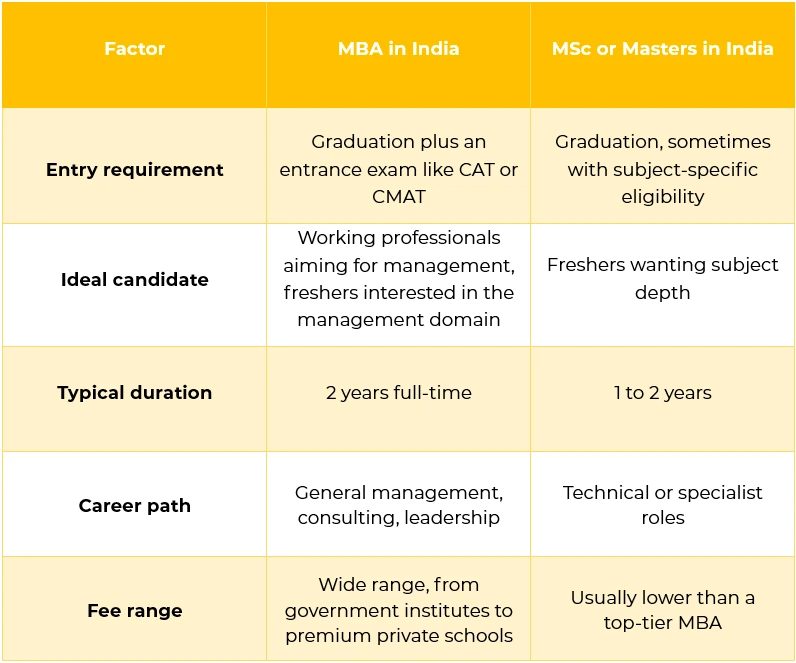
It is quite profitable to pursue an MBA in a renowned Indian business school owing to the importance that placements and alumni network have in the country. Specialized master’s degrees can be beneficial if the industry in which you wish to work demands expertise.
MBA vs Other Masters by Specialisation
Broad comparisons only take you so far. Most students actually decide field by field, so here is how MBA vs other masters plays out by subject.
MBA Marketing vs MS Marketing
Marketing MBA vs Marketing MS is one of the more popular divergences that most students who are sure about their career in marketing take. The Marketing MBA focuses on brand strategy and customer behavior, and links marketing to sales, finance, and operations.
The Marketing MS is focused on research methodologies, marketing analytics, and consumer psychology. It is very easy for you to choose between MBA marketing and MS marketing.
Difference Between Masters in Finance and MBA in Finance
A master’s in finance program is about depth, whereas a master’s in business administration (MBA) is all about breadth. While the master’s in finance will concentrate entirely on financial modeling, valuation and corporate finance, the MBA will include finance as one of the subjects. If you want to become an investment banker or an equity analyst,
the master’s in finance is what you should go for.
Which is Better, MBA or Masters in Accounting?
Whether one should prefer a master’s degree in MBA or accounting will depend upon the objective that the person wishes to achieve. A master’s in Accounting will provide the knowledge required for accounting-related jobs such as auditing, tax and financial reporting.
A master’s degree in MBA will equip the individual with the skills for managing finances and making decisions but not the knowledge related to accounting standards. The specialized degree will be useful in case one wants to work as an accountant.
How to Choose Between an MBA vs Other Masters
Do you still have confusion in choosing one among an MBA vs other master’s degrees? Here is a fast way to think through how to choose between an MBA aan nd MS.
- Check your work experience: 3 or more years usually points to an MBA; 0 to 2 years usually points to an MS
- Think about your daily work preference: leading people and solving business problems, or going deep into one technical subject
- Look at your target role: management roles need an MBA; specialist roles need an MS
- Weigh cost and duration: MS programmes tend to run shorter and cheaper; MBA programmes cost more but can pay off faster for experienced professionals
- Study your target industry: consulting and general management value MBAs; engineering, research, and core technical fields value a specialised masters
You will have to carry out these five tests truthfully, and then the answer will become clear. Most people who find this question hard to decide on are actually not uncertain about the degrees themselves. They are simply unclear about their personal objectives. After figuring out whether you wish to manage or specialize, everything else will follow suit.
Want to pursue a master’s degree? Know Why Pursue Master’s before you actually do it.
A Quick Word on Salary and Career Speed
Comparing the salaries for an MBA and any other master’s program never tells the whole story because salaries depend largely on the institute, position, and the industry you are entering. This is true; however, the trend is usually consistent across the board. Graduates from MBA programs are likely to be paid better right out of school owing to the fact that they come in with work experience in tow.
Graduates from specialized masters will typically earn less initially, but will soon catch up as they gain experience in their particular line of specialization, which could range from technology, data analytics, finance, or engineering.
It is therefore advisable not to focus only on the degree that has a higher initial salary, but to consider what the pay scale will look like after five years.
MBA vs Other Masters: The Bottom Line
Neither does there exist a winner for all when choosing between an MBA and other master’s programs. An MBA is best suited for those that are prepared to take the roles of leadership, management, and increased business responsibility. A specialized master’s degree is better suited for students that require specialization in a single discipline. Pick the program based on your level of experience and the work that you want to do day-in-day-out.
If you are still not sure about the choice that you will make, then visit a career counselor and match your background with actual placement records prior to making your decision.
Frequently Asked Questions
1) MBA or MSc, which is better in India?
It depends on your experience level. An MBA works better if you already have a few years of work experience and want a management role, since Indian recruiters value the leadership training and network that comes with it. An MSc works better for fresh graduates who want technical depth in one subject, especially in fields like data science or engineering.
2) Is MBA better than MSc, or is MS better than MBA?
Neither is better on its own. An MBA is better if you want to lead teams and move into general management. An MS is better if you want to become a specialist in one technical area, such as finance, analytics, or engineering. The right answer depends on the career you are chasing, not on which degree sounds bigger.
3) What is the actual difference between MBA and MS?
An MBA is a broad, business-focused degree that covers finance, marketing, operations, and leadership together, built for professionals with work experience. An MS is a narrow, subject-focused degree that builds deep technical skill in one area, built mostly for recent graduates. One trains you to manage many functions; the other trains you to master one.
4) How do I choose between MBA and MS?
Start with your work experience: 3 or more years usually points to an MBA, while 0 to 2 years usually points to an MS. Then ask what you enjoy more day to day, leading people and solving business problems, or going deep into one technical subject. Your answer to that single question settles most of the decision.
5) Is a masters degree or an MBA better for salary and career growth?
MBA graduates often earn more right after graduation, mainly because they walk in with prior work experience already factored into the offer. Masters graduates often start lower but grow faster within their specialised field once they build a track record. Look at the five year career path rather than just the first pay cheque before you decide.