
Have you ever stared at the sky and thought about what ties it all together? If yes, then perhaps you should know about the careers in astrophysics. Career paths in astrophysics range far beyond using telescopes. They include research laboratories, space agencies, tech companies, as well as finance firms that employ physicists due to their ability to solve problems. The following guide discusses the career path of an astrophysicist, the educational background required, and actual job opportunities available once the career goals are achieved.
What Does an Astrophysicist Actually Do?
Astrophysics investigates physical processes occurring within the realm of stars, galaxies, black holes, and the universe itself. Astrophysicists build mathematical models, create computer simulations, analyze data collected from telescopes and satellites, and test hypotheses about processes taking place in space.
For example, an astrophysicist may spend his or her time creating programs that would analyze the data collected by a space telescope. Another astrophysicist may work in a laboratory to build equipment to be placed on board of a satellite in the future.
Is Astrophysics a Good Career in India?
What is the scope of astrophysics in India? Yes, it is, provided you have realistic expectations. India is witnessing the development of its space and research culture, with organisations such as ISRO, TIFR, IUCAA, Indian Institute of Astrophysics, among others recruiting researchers and engineers on a continuous basis. In addition to this, there has been a trend of opening up the space industry to private firms in recent times in India.
However, there is no denying the fact that jobs in pure research related to astrophysics continue to be competitive across the globe including India, considering the fact that there are far fewer research posts as compared to PhD candidates annually. The positive aspect is that the skill set developed in the process, programming, analysis, statistics, and physical modeling can be put to use in other sectors also if research turns out to be unfeasible.
Bonus Tips: Know about the Conventional Careers in Quantum Physics.
Careers in Astrophysics After 12th: Where Do You Start?
Astrophysics is one career path after 12th class where the knowledge of physics and mathematics forms an essential part. The following is the path that one needs to follow:
- Complete 12th class with subjects like Physics, Chemistry, and Mathematics
- Complete a Bachelor’s program in Physics, Astronomy, or Astrophysics, either through a specialized program in physics or through a physics program with specialization in astrophysics
- Take JEST, IIT JAM, or other such entrance exams if you want to do a research-oriented master’s or integrated program
- Complete a master’s program in physics or astrophysics
- Complete a PhD if you want to go into research
Some universities abroad as well as some Indian universities offer integrated 5 year programs that include Bachelor’s and Master’s degrees.
Step by Step Pathway for Careers in Astrophysics
The astrophysicist career path is a long one, and it helps to know what each stage looks like before you commit.
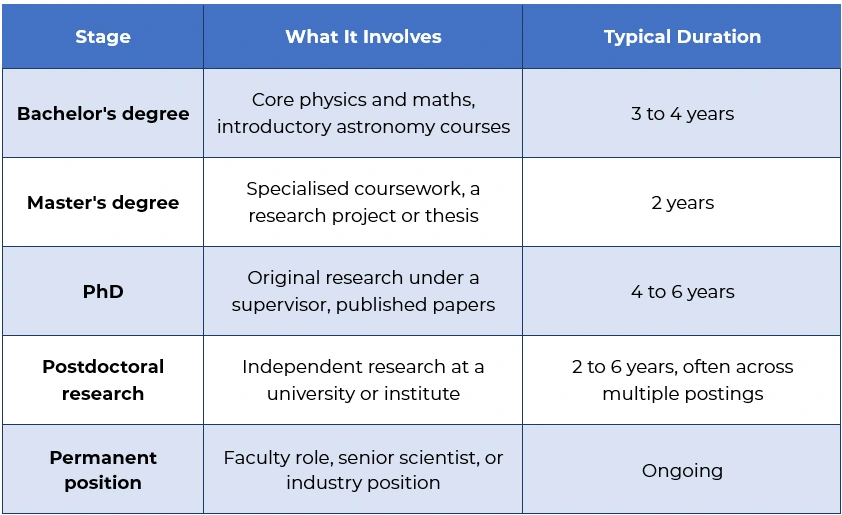
Not everyone follows this full path to a permanent research post, and that is fine. Plenty of people step off this ladder after a Master’s or PhD and move into industry roles that value the same analytical skills.
Growth Opportunities for Careers in Astrophysics in India
The scope of career options in astrophysics is much greater than most think. The job market for an astronomer or an astrophysicist does not confine itself to a professor or scientist job at a space agency. Some of the career paths that are generally taken include:
- Research Scientist position at a university, laboratory or observatory
- Positions in space agencies such as ISRO, NASA or ESA
- Instrument Scientist who designs telescopes, detectors or satellite instruments
- Science Communicator or Planetarium Educator
- Data Scientist or Machine Learning Engineer, applying the programming and statistics knowledge gained during the course of a physics degree
- Quantitative Analyst in Finance since employers find the mathematical modeling capabilities of physicists very useful
- Science Journalist or Writer reporting on space and physics
- Software Engineer, especially in scientific computing or simulation-intensive industries
Career options in astrophysics don’t necessarily mean putting on a lab coat. Many students end up working in finance and tech industries due to their analytical skills.
What Can You Do With a Degree in Astrophysics?
In case you do not wish to pursue an academic career with your astrophysics degree, what can you do? The possibilities may be surprising. How you use your astrophysics degree, therefore, ultimately depends on the areas of expertise you will cultivate while at university.
- For instance, if you like to code, opportunities in the field of data science, software development, and machine learning are readily available for you;
- if you like to work with equipment, then aerospace or optical engineering may become your specialization;
- if you like to translate difficult concepts into simple explanations, then you may become successful in science communications or teaching;
- Last but not least, if you are good with numbers and modeling, then quantitative finance is the path you can choose.
Thus, what you can do with your astrophysics degree aside from being a scientist ultimately depends on the skills you have developed.
Suggested Read: Popular PCM Career Options for You!
Job Opportunities for Careers in Astrophysics
What jobs can astrophysics get you in, concretely? Here is a shortlist of real job titles graduates move into:
- Research Scientist
- Data Scientist
- Aerospace or Optical Engineer
- Quantitative Analyst
- Science Communicator or Content Writer
- Satellite Systems Engineer
- Software Developer
- Physics or Science Teacher
The degree itself signals strong analytical ability, so recruiters outside pure research often value it just as much as a dedicated computer science or engineering degree.
Careers in Astrophysics Majors Beyond the Lab
The range of job opportunities for an astrophysics major nowadays extends beyond fields having anything to do with outer space. IT firms recruit physics graduates for positions related to machine learning or data engineering as the math knowledge is directly applicable. Finance firms recruit physics graduates for jobs in the field of quantitative analysis as the skills of modeling required for studying black holes can be equally applied to valuing financial securities. Even climate change studies and renewable energy studies require physicists now.
That is why it is important to know about it early on since it shows that choosing astrophysics as your field does not limit your options.
Skills Required for Careers in Astrophysics
Whatever path for astrophysics you pick, a few skills consistently help:
- Strong programming ability, particularly in Python
- Comfort with statistics and large datasets
- Clear scientific writing and communication
- Patience for long, uncertain research timelines
- Willingness to keep learning new tools and techniques
Building these alongside your core physics knowledge keeps your options open, whether you stay in research or move into industry later.
Final Thoughts
Careers in astrophysics are equally suited for both curiosity and patience. The tried-and-true path from PhD through to post-doctoral research is alive and well for anyone who wants to remain firmly in the world of science. That said, all of the skills acquired along the way offer opportunities in technology, finance, engineering, and teaching, making the degree much less likely to be a dead-end venture. Select the area of specialization you find most fascinating and develop your skills in parallel.
Frequently Asked Questions
1) Is astrophysics a good career in India?
Definitely, provided that you develop good programming and data analysis skills in addition to physics knowledge. In India, there is an expanding space industry with space organizations such as ISRO and IUCAA, in addition to Indian private space companies which hire scientists. While pure research jobs remain competitive, the skills which you develop can be used in technology- or finance-related industries in case research doesn’t work out for you.
2) What is the typical astrophysicist career progression?
It starts with a Bachelor’s degree in Physics or Astrophysics, then it goes on with a Master’s degree, a PhD and sometimes several years of postdoctoral research. However, not everyone follows this trajectory, and many people join the industry after getting either a Master’s or a PhD degree.
3) What are some other possible professions if you have a degree in astrophysics except for doing research?
You can go into data science, software engineering, quantitative finance, aerospace engineering, or science communication.
4) What career options can you pursue in the field of astrophysics beyond academics?
Typical careers include Data Scientist, Quantitative Analyst, Aerospace/Optical Engineer, Satellite Systems Engineer, and Science Writer. HR professionals in the field of technology and finance always appreciate the analytical mindset of a candidate with an educational background in astrophysics.
5) How do I begin my career in astrophysics after 12th?
Select Physics, Chemistry, and Mathematics as your subjects in the 12th class, and then pursue a bachelor’s in Physics or Astrophysics. After that, you can appear for entrance examinations like IIT-JAM or JEST and pursue a Master’s and PhD in the field of astrophysics.