Introduction
As a career coach, you would have faced this before. A student walks in with complete confidence saying they want to be a psychologist, a game designer, or perhaps one of the most popular careers of this age — an influencer.
There is nothing wrong with that confidence. In fact, it is a good place to start. A student may genuinely love the idea of becoming a doctor, lawyer, psychologist, entrepreneur, content creator or game designer. But liking a career title is very different from liking the work behind it.
And as a career coach, your job isn’t to shake that confidence. It is to help the student test it before they build an entire academic and career plan around it.
Understanding a student’s interest before helping them choose a career path is important because it can help determine whether the career is likely to be a good fit for them in the long run. For instance, a student may believe that they are interested in a specific career solely because they are unaware of what it entails, including its demanding nature and the skill set required to excel in it.
Luckily, a student does not have to commit to choosing a specific career immediately. By asking the right questions and providing students with relevant experiences and conversations, a career coach can help them explore their interests and make more informed choices before a stream selection, college application or family discussion makes the decision feel final.
This blog looks at some practical ways career coaches can help students test, evaluate and make sense of their career interests before taking the next big step.
Why “I’m Interested” Isn’t Enough to Make a Career Decision
A student’s interest in a career can come from very limited exposure. As a coach, you’re likely to see three patterns come up repeatedly:
- Interest based on image, not information – the career looks glamorous, exciting or impressive.
- Interest based on one good experience – a particular subject, project or teacher made the student enjoy it.
- Interest based on external validation – family, peers or social media have reinforced the choice.
None of these interests are necessarily wrong. The question is whether the student has explored the career enough to know what they are actually signing up for. Before helping the student develop a career plan based on the interest, it will be important to explore where the interest is coming from and what the student thinks the career based on the interest would entail.
A Career Coach’s Framework to Test Student’s Career Interest
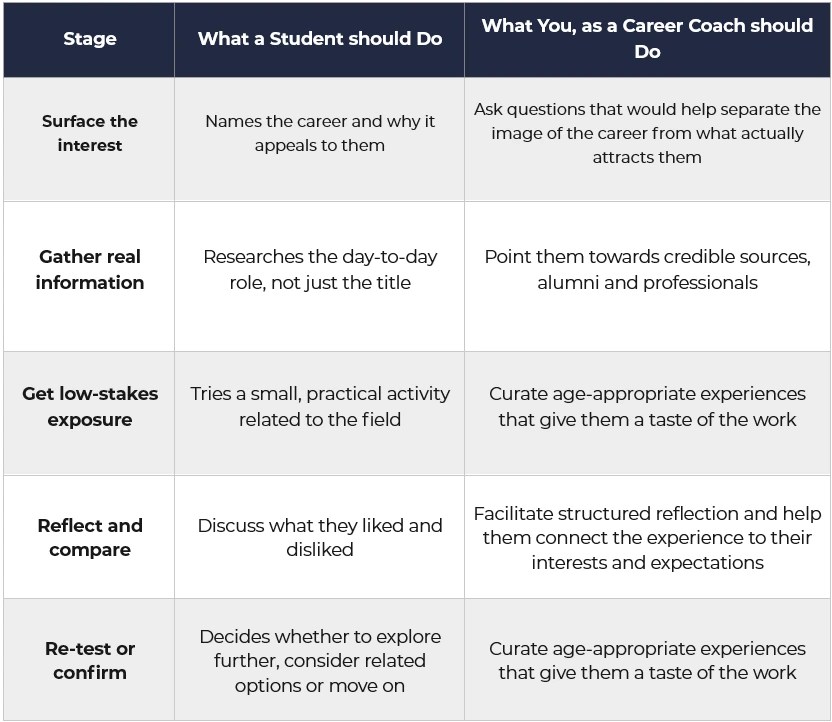
Once you understand where a student’s interest is coming from, the next step is to help them explore it before they commit to a particular path. This does not mean an internship or professional exploration right away, although that can be a good possibility. There are other steps that can be taken to allow a student to gain enough exposure so they can feel confident about their choice before committing fully. A career coach can take the student through five simple stages:
| 💡Tip: Encourage students to keep a running journal across every exposure activity. |
Tools and Techniques Career Coaches Can Use to Help Students Explore
Once a student is ready to move past conversation and into actual testing, having the right tools on hand makes the process far easier. Here are the tools and techniques worth building into your coaching practice.
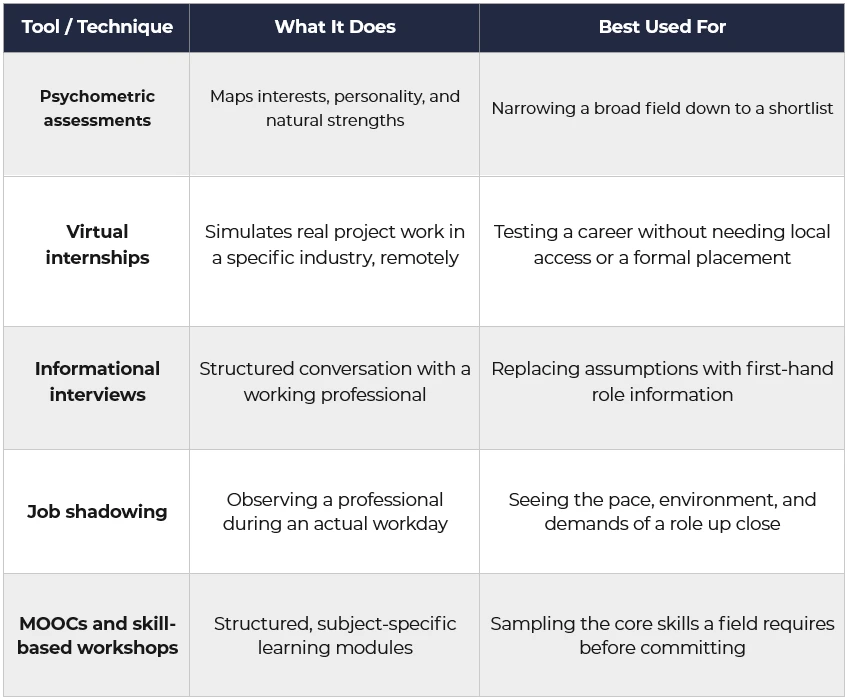
A few suggestions on the use of these tools:
- Psychometric Assessments are meant to be a starting point, not a final answer. In other words, use them to narrow down the field to two or three options to explore further, rather than to identify the one and only career path the student should pursue.
- Virtual internships are perfect for students who do not have access to someone in their desired field to serve as a mentor or provide the experience of that profession. They can be used to gain hands-on experience of a career without actually getting an internship which would be harder to do.
- Pair every tool with reflection. A completed assessment or internship without a follow-up discussion is just an activity. The real insight comes from what the student takes away from the experience. A follow-up conversation can often reveal more than the activity itself.
- Try to use a mix of tools rather than relying on just one. A student who only takes assessments, for example, may get a very different picture from one who also speaks to professionals or tries a project.
How Career Coaches Can Help Students Evaluate the Experience
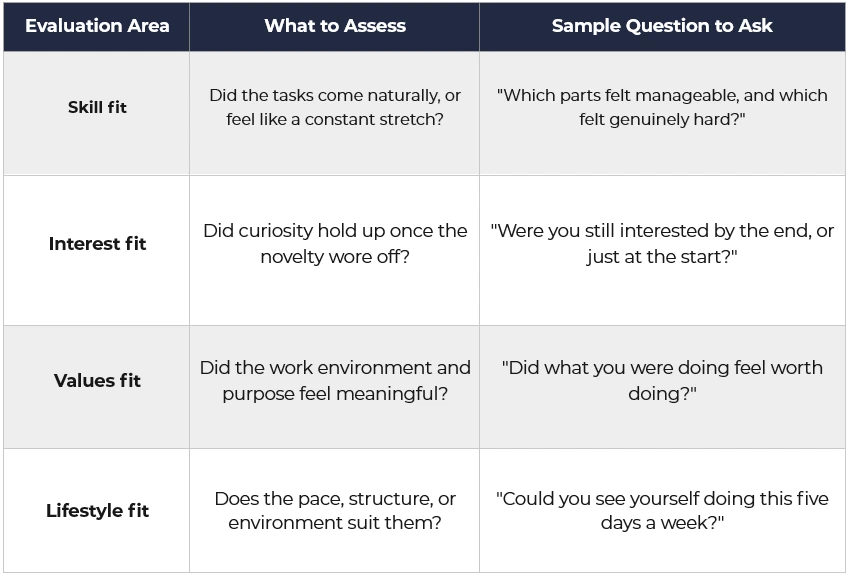
Reflection tells a student what they felt. Evaluation helps them decide what that feeling actually means. Most students can usually tell whether they enjoyed an experience but a career coach can help them understand what that reaction actually means and whether it tells them something about career fit.
A simple way to structure this is to evaluate every exposure activity across four areas:
What Career Coaches Should Avoid
Career exploration can lose its value when the focus shifts from helping students discover to trying to give them a definite answer too quickly.
Career coaches should avoid:
- Treating one assessment result as a final career recommendation.
- Recommending a field simply because it is popular or well-paying.
- Assuming a certain career fit based on academic performance.
- Giving students a long list of careers without helping them explore them meaningfully.
- Telling students to simply “follow their passion” without helping them understand what that passion looks like in practice.
- Treating a change of interest as a failure during the exploration phase.
Key Takeaways for Career Coaches
- Start with curiosity. Explore the interests of the student and learn the reasons why they may be interested in a certain career before pushing them towards an area.
- Look beyond the job title. Help students understand the actual tasks, skills and environment involved.
- Start with assessments. These can be a good way to begin exploring potential careers, but students need opportunities to research and discover other jobs in their areas of interest.
- Give students something to try. Students benefit more from opportunities like to-do projects, simulations, talks, job shadows, or internships that will help them acquire information relevant to their career decision.
- Reflect, reflect, reflect. Help the students to reflect and understand what they learned from the experience about the explored career.
- Keep options open. Testing one career can often lead students towards related options they had not considered.
- Remember that ruling out a career is also progress. Knowing what does not fit is much better than wasting years of their life pursuing an inappropriate field.
Conclusion
Helping a student test a career interest before they commit isn’t about slowing them down. It is about giving them the reassurance and confidence to feel that their decision is right for them. A student doesn’t always need to experience the whole career that they are interested in to see if it is something that they want to pursue. By asking the right questions, having the relevant experiences and putting things into perspective, students can view their career choices differently.
If you’re building out your own career coaching practice around this kind of structured, evidence-based guidance, Mindler’s ICCC certification program equips coaches with the frameworks, assessments, and exposure-based tools to guide students through exactly this process.