
Best Career Options After 12th Commerce with Economics: Complete Guide
Year after year, countless commerce students enter the 12th grade only to be confronted with this query: “What should I do with economics?” Very often, they fail to comprehend that economics, in all its simplicity, is subtly but surely transforming into one of the most highly sought-after talents within the industry spectrum. In this blog, we shall know about the best career options after 12th commerce with economics.
While previously associated with graphs, theory, and the politics of the government, economics is fast emerging into much more than a mere academic study. Businesses, banks, consultancies, and even tech companies are increasingly relying upon economic thought processes and data-oriented decision-making. As a result, more and more commerce students are considering economics as a lucrative field of work right after the 12th. The beauty of economics lies in its vast applicability in diverse industries, combining analytical prowess with business acumen seamlessly.
At the same time, commerce students tend to wonder what sort of scope one has in economics, and what jobs and courses are actually available in the sector.
Why Economics is Becoming a Popular Career Choice
The need for economics graduates has grown over the past few years. Businesses are increasingly relying on market analysis, understanding of consumer behaviour, prediction, and evidence-based decision-making. It has led to the inclusion of economics in various industries, other than the finance and government sectors.
For instance, businesses such as Amazon and Flipkart recruit experts in economics and data analysis to help understand pricing trends and forecast consumer demands. This indicates that economic knowledge is integrated into the operational aspects of today’s firms.
The ‘Future of Jobs Report 2025’ by the World Economic Forum cites problem-solving and analytics as the most crucial skills globally. The learning of these skills is provided through the study of economics.
Economics is also versatile; students love it. Graduates of economics may become employees of finance, consulting, analytics, government policy, and even in technology-related jobs. This flexibility in economics is an option that is favorable to students who desire flexibility in their careers.
Why Choose Economics After 12th Commerce?
The study of economics offers you the rare opportunity to explore the workings of your surroundings, the reasons behind inflation, the way businesses function, factors of growth and the impacts of government policies on your day-to-day life. Economics is not only a theoretical subject but it is practical as well; therefore, it provides you with both the excitement of learning and its applicability as well.
Some of the advantages of choosing economics as your course after class 12 are:
- Enhances analytical abilities: An economics education helps you analyze things and draw logical conclusions, which is essential for everything.
- Helps in solving problems: Whether it is a problem with markets or consumers, economics allows you to find solutions for all sorts of problems.
- Provides you with various job prospects: You can choose to work in fields like finance, consultancy, technology, etc.
- Strong basis for higher education: Economics is a suitable choice in combination with MBA, public policy, data sciences, and development studies in postgraduate courses.
- Applicable in private and government sector jobs alike: Whichever path you may choose after completing school, economics will always keep your doors open.
If you enjoy working with numbers, understanding human behaviour, and analysing how decisions shape society, economics could be the right foundation for your career.
Best Economics Courses After 12th
You have a few options for undergraduate economics courses, depending on your interests and career aspirations.
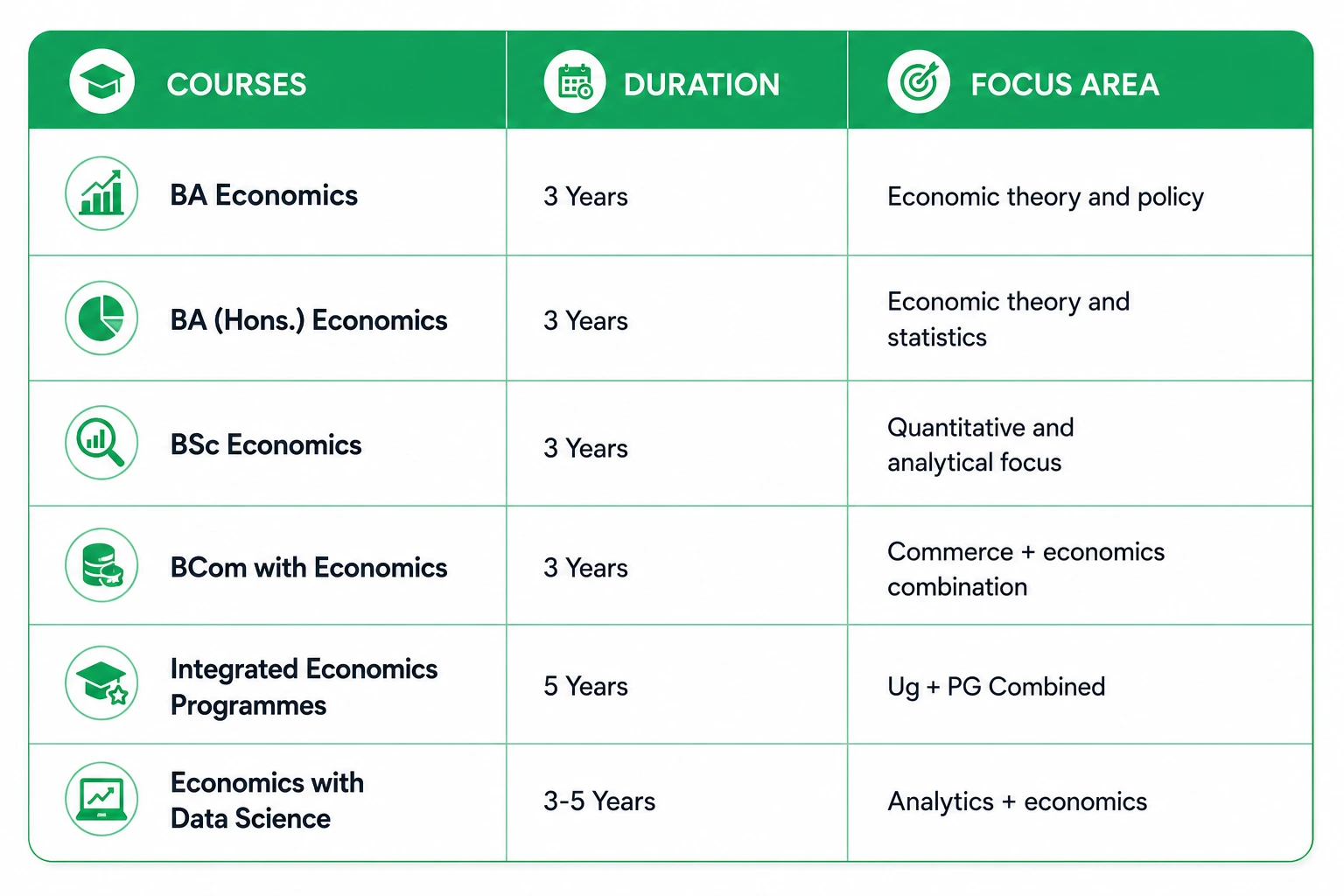 It is through these economics courses post 12th that a sound foundation is formed for econometrics, statistics, business economics, and research methods.
Best Career Options in Economics
Another benefit of pursuing studies in economics lies in the number of career options that open after one studies economics.
Some of the top jobs in economics include:
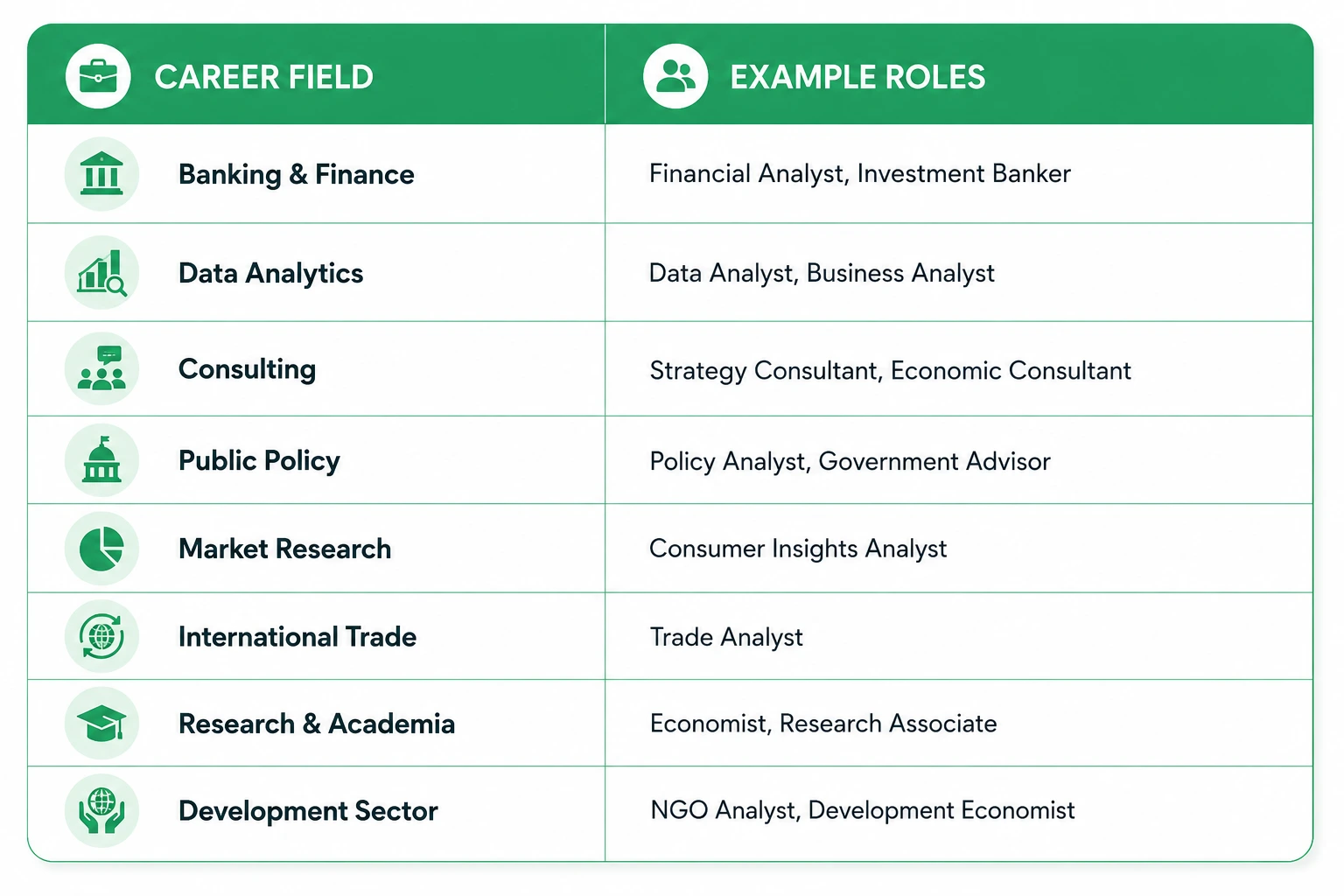 These positions demonstrate the diverse opportunities available for economics graduates.
Careers in Economics Education
Not everyone who studies economics wants to work in business or finance. For those who love learning, studying, and teaching, the field of education and research provides ample scope and satisfaction.
An economist who loves teaching can have a satisfying career as an educator or professor in college and university settings. Those interested in conducting research can choose to be research analysts and economists who contribute to think tanks, governments, and international organisations. Academic writers and curriculum developers play a very important role in economics education.
Career options in economics education include:
- Lecturer or professor
- Research analyst
- Academic writer
- Curriculum developer
- Policy researcher
These professions provide intellectual challenges and give one the chance to impact policy-making, education, and even thought processes. Postgraduate students in economics automatically fall into these categories, as their strengths complement their profession.
Career Options After 12th Economics
Many students have the misconception that economics can only get them into banking and government services.
However, many new prospects have opened up. Some of the new careers after 12th economics are:
- Behavioural economics
- Financial technology (FinTech)
- Sustainability and ESG analysis
- Economic journalism
- Business intelligence
- Risk analysis
These options reflect how the scope of economics after 12th continues to evolve with industry trends.
Career Options for Economics Graduates in Emerging Fields
With the rise of digital transformation, economics graduates are entering new-age roles as well.
Some growing economics degree career options include:
- Economic forecasting
- Financial modelling
- Data-driven strategy roles
- Digital market analysis
- Sustainability consulting
- Policy analytics
The above mentioned career paths are indicative of how the scope in economics after 12th is evolving.
The above mentioned careers not only have great earning potential but also great job security. Salary packages for entry-level jobs such as financial modeling and economic analysis start at around ₹6 – 12 LPA. More experienced employees working in consultancy companies and MNCs make much more money. Individuals with expertise in both economics and data science or finance technology can earn as high as ₹20 – 30 LPA.
Jobs You Can Do With an Economics Degree
Economics graduates are equipped with versatile skills. These are research, analysis, and decision-making skills.
Some jobs after a degree in economics include:
- Economist
- Financial Analysis
- Data Analyst
- Market Research Analyst
- Business Consultant
- Policy Advisor
- Risk Analyst
- Investment Analyst
These are the kinds of jobs for economics majors that are in demand as businesses need data and information.
Skills for Careers in Economics
You need to focus on gaining skills in addition to knowledge if you want to have good career options for economics majors.
Important skills include:
- Data interpretation
- Statistical analysis
- Research and reporting
- Critical thinking
- Financial understanding
- Communication skills
- Excel and analytical tools
These have a direct bearing on the career options in economics that are available to you.
Further Study in Economics
Students can opt to pursue specialisation. Some popular post-graduate degrees include:
- MA Economics
- MSc Economics
- MBA
- Data Analytics
- Public Policy
- Development Studies
How to Choose the Right Career Path
Choosing an ideal career option for you, given that you are an economics major, is much more than just succumbing to the wave or following the most lucrative route.
Rather, it involves introspection and proper research. For instance:
- What topics do I find very exciting: markets, statistics, politics, or operations in the business environment?
- Do I feel comfortable dealing with numbers or would I prefer doing research and writing?
- Am I keen on working in the corporate world, government organizations, or am I interested in conducting research on my own?
- What do I see myself doing in the next five to ten years?
- In which sectors is the industry booming and will be in demand in the future?
These are very good questions to start with. However, some students find it difficult to determine which careers match their skills and preferences. In such cases, career counseling services can make a significant contribution to your professional development.
The Scope in Economics After 12th
Today, the scope in economics after 12th is growing due to the expanding role of data analysis, forecasts, and planning in different sectors of the economy.
The Deloitte’s ‘Gen Z and Millennial Survey’ report shows that lifelong learning, flexibility, and analytical thinking are becoming key skills in the job market. This has seen economics become important not only in traditional industries but in fintech, analytics, and consulting as well.
Key Takeaway
Economics is still a growing and lucrative field for commerce graduates. Economics graduates have many career options. Economic graduates can now work as consultants, analysts, in finance, policy, and in the new digital economy.
Students will also be able to seek guidance for making proper career decisions at Mindler.
In the case of selecting from among careers in the field of economics after 12th, it is important that you do not just make your selection based upon what the latest trend or salary might be. Having a good knowledge about yourself may also be useful in this regard.
FAQs
What skills do I need to succeed in economics?
Analytical skills, mathematics, being able to interpret data, and having an interest in markets, public policies, and financial systems are valuable.
What’s the difference between BA Economics and BSc Economics?
BA Economics is more focused on theories and social science. While BSc Economics is more focused on mathematics and statistics.
Is there a demand for economics graduates?
Yes, there is due to the demand for data analysis skills. There are lots of job positions for economics students in banks, consulting, data analysis, public services, fintech, etc.
Is mathematics necessary to study economics?
Yes, in universities where one studies either BSc Economics or BA (Hons.) Economics. It varies depending on a university.
Is economics a subject for international employment?
Yes, as there are job openings in international trade, international finance, NGOs, and international businesses.