
You checked the cut-offs, and your score missed your dream college by just a few marks. What now? College admissions in India are becoming more competitive each year, with limited seats in top institutions and intense competition among applicants. Relying on a single college is risky, which is why building a backup college plan is essential for students applying in 2026. A smart strategy is not about lowering your expectations, but about keeping multiple realistic options open.
By identifying good alternative colleges, you eliminate uncertainty and keep your admission journey on track, even if your first choice does not work out. You can still have a quality education. This guide explains how to develop a good and realistic backup plan, how career counselling, psychometric tests, and professional advice from a career coach can assist, and what the practical steps are that the students should follow during the time of admission.
Key Takeaways:
- Creating a backup of colleges ensures you have multiple admission opportunities.
- A strong backup plan includes colleges with varying competitiveness.
- Career counselling and psychometric assessment help identify suitable career options and colleges.
- It is ideal for students to list the top alternative colleges in terms of courses, rankings, and admission requirements.
- Expert advice from organisations such as Mindler can streamline the admissions planning process.
- Early preparation increases the chances of securing a seat in a good institution.
Why Students Need a Backup Plan for College Admission
Many students focus only on their dream college. Even a small difference in marks can affect admission results. That is why the most appropriate backup plan still offers you the chances of admission in reliable colleges. Although having high aims is important, admissions are generally made on the basis of various elements that are not predictable, such as:
- Entrance exam scores
- Cut-off changes each year
- Competition levels
- Reservation categories
- Limited seats in top colleges
What Does a Good Backup Plan Look Like?
The most effective backup plan is not only to choose a number of random colleges. It is a well-planned and realistic strategy that demonstrates that the student is informed about their career opportunities. With a planned-out choice, students can plan what to do strategically and not in a state of confusion. An ideal backup plan will comprise:
- A list of dream colleges
- The list of the best alternative colleges that have the same academic quality
- A shortlist of good backup colleges where admission chances are higher
How to Create Backup Plans for College Admission in 2026
Backup colleges are colleges that you apply to, as well as your dream college. Such colleges are slightly less or more feasible, but have good academic prospects.
Winning over the college admissions process necessitates research, analysis, and tactical implementations. The steps mentioned below outline the process of developing the most effective backup plan.
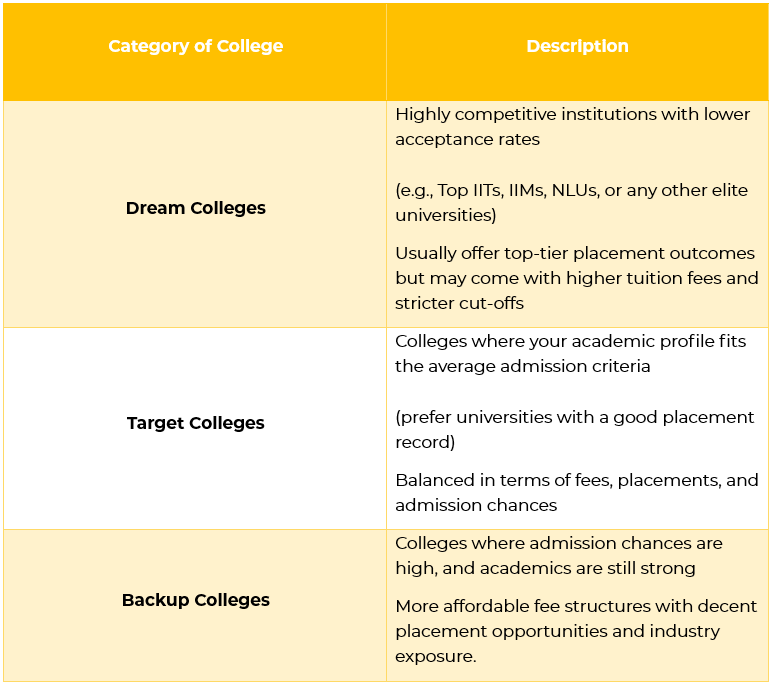
1. Identify Your Dream, Target, and Backup Colleges
Students should divide their college list into three categories to ensure they have multiple opportunities across different difficulty levels.
2. Research Good Backup Colleges Carefully
Not every backup college is a low-quality institution. There are many universities available with good academics, industry exposure, and placements. In many cases, there are other colleges that you chose as fallbacks, and they can offer you the same learning experience as the best universities. Through research, students often find the best academic programs that match their expectations, and some of the good backup options. When picking good backup options, take the following things into consideration:
- Accreditation and ranking
- Faculty quality
- Placement records
- Campus facilities
- Internship opportunities
3. Align College Choices With Your Career Options
This is one of the common mistakes that students make. Choosing backup colleges that fail to help them pursue their career choices. Your backup strategy must support long-term career development rather than just serve as an admissions process for the college.
For example:
- In case you intend to take engineering as a course, seek colleges that have good technical laboratories and industrial partnerships.
- In case you are interested in the law, make sure that the university has well-developed moot court programs and internships.
- In case you are considering a career in management or business, analyse the entrepreneurship opportunities and the alumni network of colleges.
Whenever you are looking at other options after competitive tests, keeping a plan B can lead you to success.
4. Use Career Counselling to Make Better Decisions
Career guidance is a methodical process where specialists help students to know their interests, their strengths, and their careers. It helps students to prevent making random choices and rather make backup plans for college admissions. If you want to understand the broader admission process, explore Mindler’s college admission guidance to help you with professional admission support.
A professional career coach can help the students:
- Assess academic strengths.
- Determine appropriate college courses.
- Suggest the most efficient alternative colleges.
- Design personalised strategies for admission.
5. Take a Psychometric Assessment
A psychometric assessment is a scientifically based test that is applied to test the interests, aptitudes, personality characteristics, as well as cognitive ability of a student. Students can make the right decisions rather than choosing colleges based on their popularity.
The assessments are very popular in the current career counselling as they assist students to:
- Identify suitable career paths
- Understand their learning styles
- Shortlist relevant college courses
- Choose the best alternative colleges aligned with their strengths
6. Apply to Multiple Colleges Strategically
The other important aspect of the best backup plan is the application to a number of entrance exams and to various institutions as well. The approach would make sure that you keep a variety of choices in the admission cycle. As a student, you should at least have 5 to 8 colleges in your hand at the time of admission. It is also better to include both entrance-based and merit-based options in your college backup plan. Always ensure to check the admission deadlines of the colleges that are on your list carefully.
7. Evaluate Placement and Industry Exposure
Sometimes best alternative colleges offer excellent placement outcomes even if they are not the most famous institutions. Many students discover that their backup universities and colleges provide strong career opportunities that match or even exceed expectations. Therefore, it is always a good idea to look for:
- Average salary packages
- Internship partnerships
- Industry collaborations
- Alumni success stories
8. Compare Colleges Using a Simple Evaluation Table
Creating a comparison table helps students evaluate good backup colleges objectively. This comparison helps students create a practical backup plan. Here is how you can create one for yourself:

Similarly, create your own table to compare colleges and make a better-informed admission decision.
Common Mistakes Students Make While Creating Backup Plans
It is possible to make several errors when developing backup plans for college admission. In the process of designing emergency plans to get admission to colleges, learners end up committing unnecessary mistakes. Some common mistakes include:
- Late planning usually fails to provide applications in time.
- The choice of college, which is not based on career choice, can result in unhappiness in the future.
- Rankings are not the only factor to judge the quality of programs or the student experience.
- Failure to engage the professional advice of a career coach who would assist you in developing superior admission strategies and assist you in crafting and planning your career ahead.
- Admissions based on peer decision should not be followed since the choice of colleges will be based on individual career aspirations, rather than that of friends.
- Choosing too few backup colleges can increase the risk of not getting final selection.
Final Thoughts
College admissions planning is not only about planning to attend the best universities. With a good backup plan in place for college admission, you are assured of having good alternatives at any time. Researching good backup colleges, searching for the best alternative colleges, and matching your options to your career options will help you develop a smart and reliable approach to the admission process.
Students who use early research with career advice and counselling, psychometric testing, and mentoring by a career coach are much more assured in the process of the admission season. Start by shortlisting at least 5-8 colleges across dream, target, and backup categories, review their cut-offs, fees, and placement records, and keep track of application deadlines to avoid last-minute stress. You can also seek expert guidance through Mindler’s personalised college admission guidance online, and build the best backup plan that keeps your academic journey on track.
FAQs
1. What is the most effective contingency plan with regard to admissions to college?
The most effective backup strategy is to research and apply to different colleges that have different admission levels, such as dream colleges, target and backup college options.
2. How do students find good backup colleges?
The best backup colleges can be identified through researching the rankings, placement records, faculty expertise, and curriculum of courses by the students.
3. What is the value of career counselling to college planning?
Career counselling can assist students in knowing their strengths, searching for the right career choices, and colleges in line with their abilities and aspirations.
4. How many backup colleges should I apply to?
Students are supposed to apply to 3 to 5 good backup colleges and dream and target universities to ensure that students have several prospects of admission.
5. What is the role of a psychometric assessment in college selection?
A psychometric test is used to determine aptitude, personality, and interests, and enables the student to select the appropriate courses and optimum alternative colleges.