
In 2026, the title of Doctor won’t simply refer to professors and medical professionals anymore. It’s a title that, throughout boardrooms and planning rooms of the country, symbolizes the mark of profound knowledge and specialization in the field of leadership. Yet, the desire to achieve a doctoral degree is frequently interrupted by the harsh realities of a full-time job.
The question that frequently arises is, ‘How to do PhD in India while working?’ Is it possible to balance the challenges of a research-oriented life with the daily routine of a 9-to-5 job? The answer is affirmative, and the path to achieving a doctorate has been made easier with the new UGC guidelines and the various options available for learning. Whether you’re looking to do your part-time PhD from India or searching for the best universities for a PhD in India, the journey has been made easier.
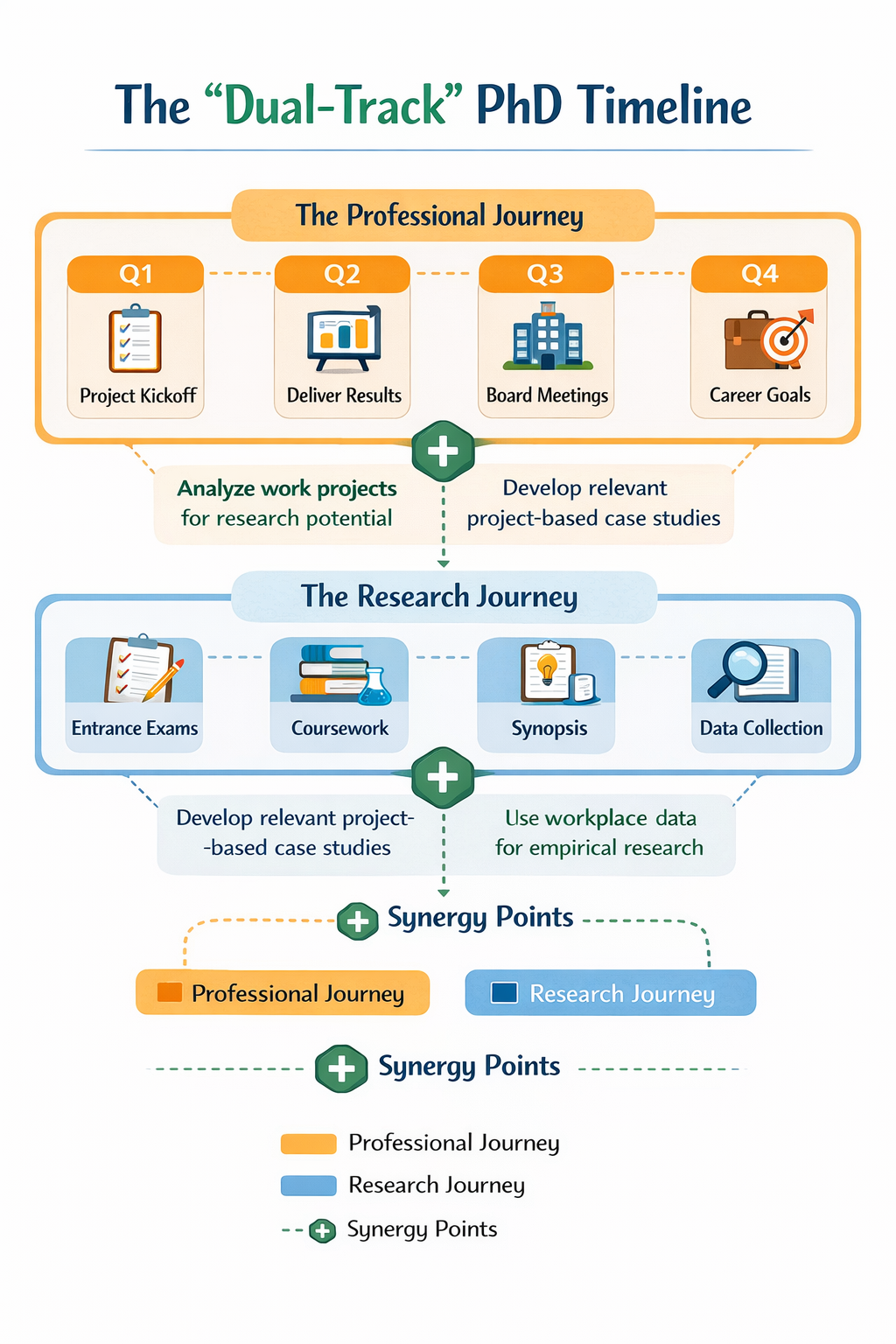
The Landscape: Pursuing a PhD while Working
Short answer: Yes, you can. But you have to be aware of the rules and regulations governing the same. The UGC has always been skeptical of the concept of an ‘online PhD’ in India.
Online PhD in India: As of 2026, the UGC does not allow a 100% online PhD. Be careful of claims like ‘1 year PhD programs online India.’ They are not recognized by any of the regulatory authorities in India. It will adversely affect your educational reputation.
Part Time PhD in India: This is the recommended mode for working professionals. It requires the same level of research work but includes a ‘coursework’ component.
Eligibility Criteria for PhD Courses in India
Before you start looking for an easy way to attain a PhD programs in India, you should first check the following eligibility criteria for PhD courses in India:
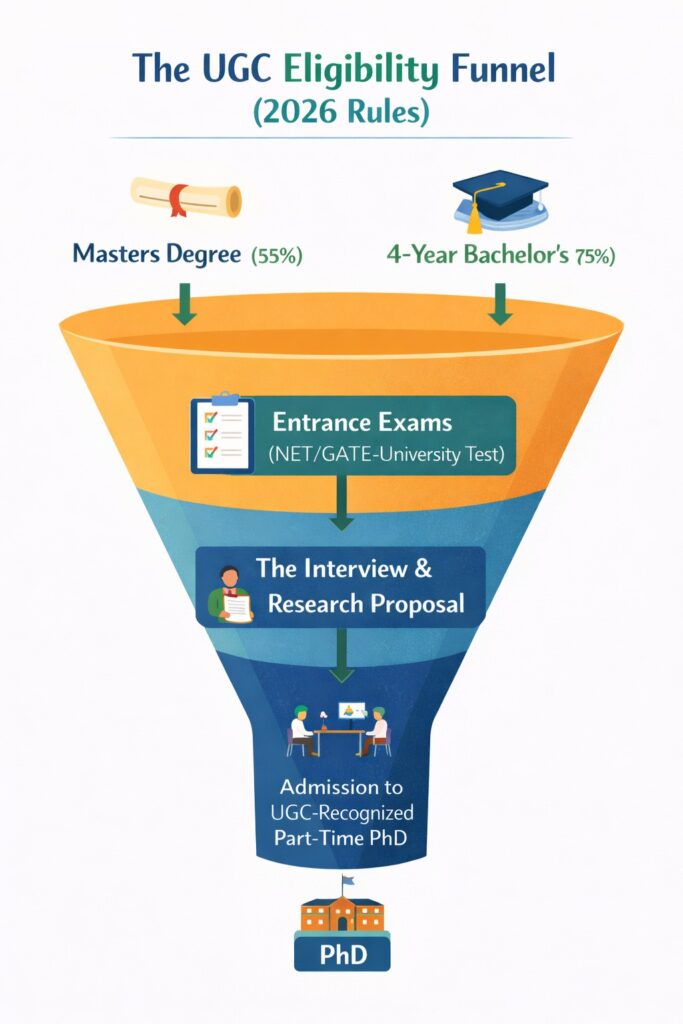
- Educational Qualification: A Master’s degree or an equivalent professional degree with at least 55% marks (50% in case of candidates belonging to reserved categories).
- Four-Year Undergraduate Course: Under the National Educational Policy, students with a 4-year bachelor’s degree and a minimum of 75% marks or equivalent CGPA can now directly enrol for a PhD.
- Entrance Exams: Many PhD courses in India require clearing entrance exams like UGC-NET, CSIR-NET, or GATE. Some of them also hold their own entrance exams, like RET and PET.
How to Complete a PhD in India While Working: A Flexible Step-by-Step Guide
Here are the easy way to get PhD in India, explained step by step:
Step 1 – Choose a Research Area
Instead of a topic, identify a problem. Try to align this with your current job for easier data collection, and “Leverage Education” – the concept of using the experience for practical leverage.
Step 2 – Crack the Entrance Exam
This is a no-brainer if you are a working individual. UGC-NET is a crucial exam to attempt. Not only will this prove your capability, but you will also become eligible for several scholarships.
Step 3 – Find a Guide
This is arguably the most important step. Try to find a supervisor who understands the challenges of a working individual. We have a useful article on “How to Find a Potential PhD supervisor” – do read this to know the approach.
Step 4 – The Interview & Proposal
Be ready to present a “Research Proposal.” This should include an explanation of the study plan, importance of the study, and the methodology to be used.
Step 5 – Course Work
Coursework is a must for part-time PhDs too (approximately six months to one year). Today, many universities offer evening courses for this.
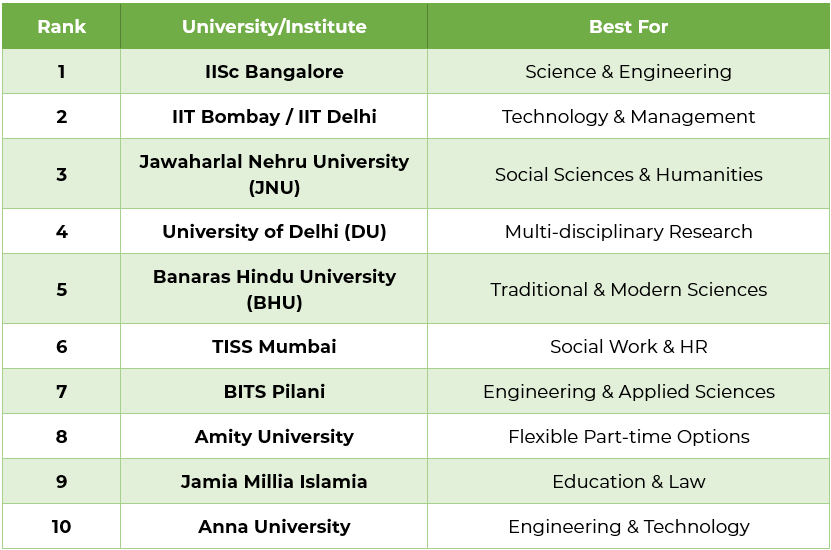
Top 10 PhD Universities & Colleges in India (Rankings for 2026)
In determining how to complete PhD in India, one factor that is important is the reputation of the institution. Here are the top universities in India that are recognized for their excellence in research:
Challenges and Survival Tips for Working Professionals
Earning a PhD for working professionals in India is a long and tedious process.
The NOC Requirement
If you are currently employed, many universities require a No Objection Certificate (NOC) from your employer. This is a document that will prove that your company supports and approves of your decision to earn a PhD.
Time Management
There is no shortcut to successfully completing a PhD in India. Be prepared to spend many weekends in the library or lab. If your field of research is related to your current job, you can consider using your work as a living lab.
India vs. Abroad
Some professionals are confused about whether it is better to pursue a PhD in India or abroad. Here is our detailed analysis of India vs. Abroad.
Final Thoughts
Seeking a PhD in India while working also reflects your commitment to your domain. It is not just about the title you will receive at the end of the program, but also the intellectual discipline that you will develop as a specialist in your domain. With the right program and a career path that is combined with a well-structured research program, the sky is the limit for your academic success without compromising your career.
Still unsure about your research niche and the right university to pursue your PhD program? Talk to Mindler’s Expert Career Coaches and let’s map out your journey to becoming a Doctor of Philosophy today!
FAQs
1) Is a part-time PhD as valuable as a full-time PhD?
Yes. It is the same in terms of the actual PhD awarded by the UGC and employers. It is only in terms of duration and stay that it is different.
2) Can I finish a PhD in 1 or 2 years?
Not really. In India, it is at least a 3-year course. A 1 year PhD program online India is not recognized by the UGC.
3) Do I get a stipend for a part-time PhD?
There are very few chances. A stipend is mostly for full-time students who are not currently employed.
4) How do I start the process?
Start by clarifying your interest in a subject, and then check out the PhD admission announcements in the top 10 PhD universities in India in May-June or November-December.