
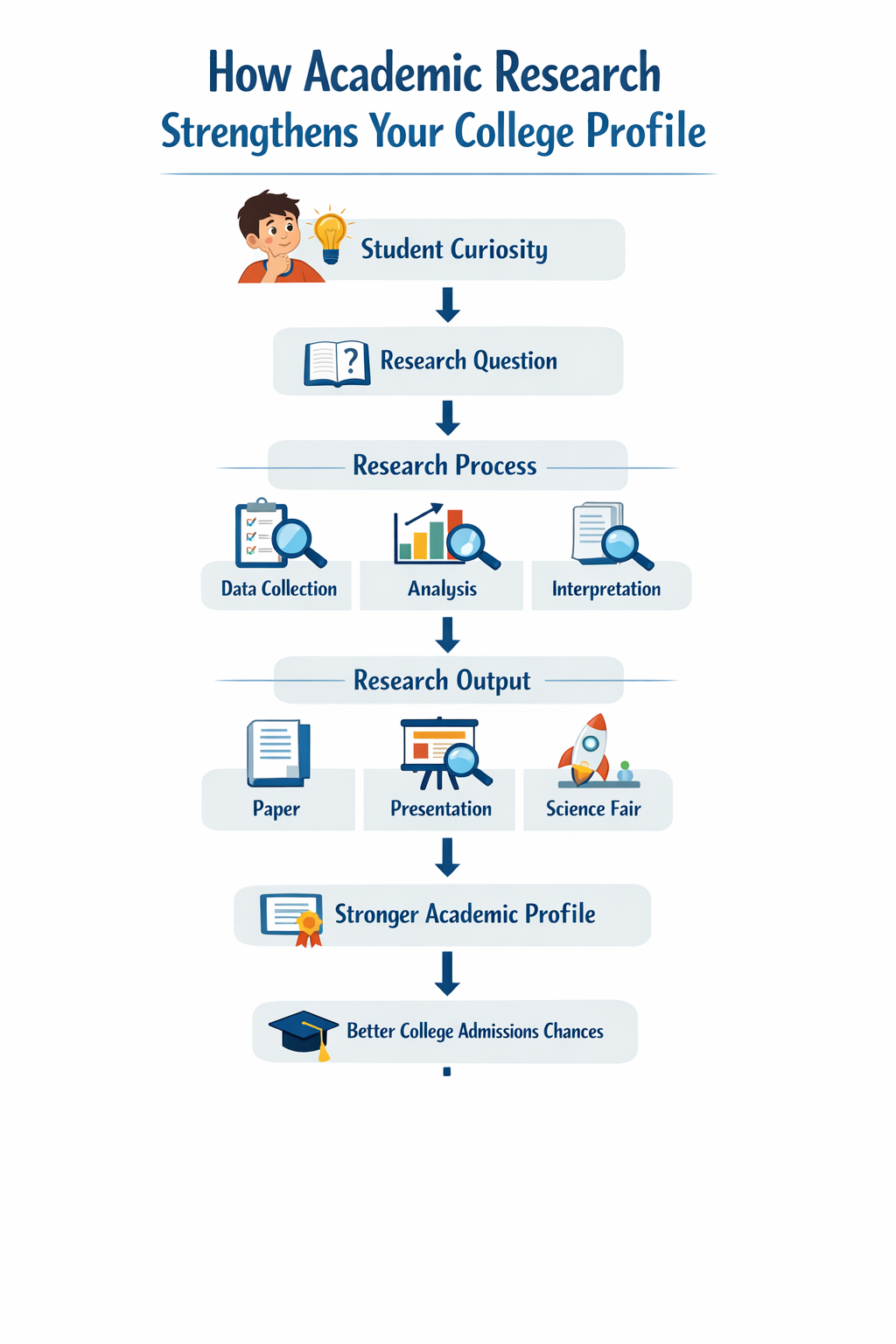
In the competitive environment of college admissions in 2026, scoring high in board exams is often the minimum requirement. Be it an Ivy League school in the US or one of the top educational institutions like Ashoka or IIT in India, admissions are looking for one thing: curiosity.
One of the strongest ways to do that is through academic research. Creating a ‘research profile’ is no longer limited to PhD students; it has become an important part of education branding for high schoolers. Through academic research work, you portray how you aren’t just consuming knowledge, but you also create it.
In this guide, let’s discuss how you can leverage education research to change your academic profile from a list of grades into a narrative of discovery.
Why Research Stands Out as the Gold Standard for Profiles
Traditional measures like GPA and test scores show that you can do well in a prescribed curriculum. Research about academics, on the other hand, shows that you can lead, create, and think for yourself.
What Research Tells Admissions Committees:
- Resilience: Research rarely goes smoothly the first time out. That’s exactly the point: research shows you’re capable of coping with the friction of academics and persevering in the face of obstacles.
- Mastery of Soft Skills: From time management to the art of technical writing, research helps you develop the soft skills that are vital for success in college.
- Specialization (The “Spike”): Research changes you from a student who “likes Biology” to someone who “researched the effect of soil salinity on urban farming in a semi-arid region of Rajasthan.”
 The Researcher’s Toolkit: The Core Skills to Cultivate
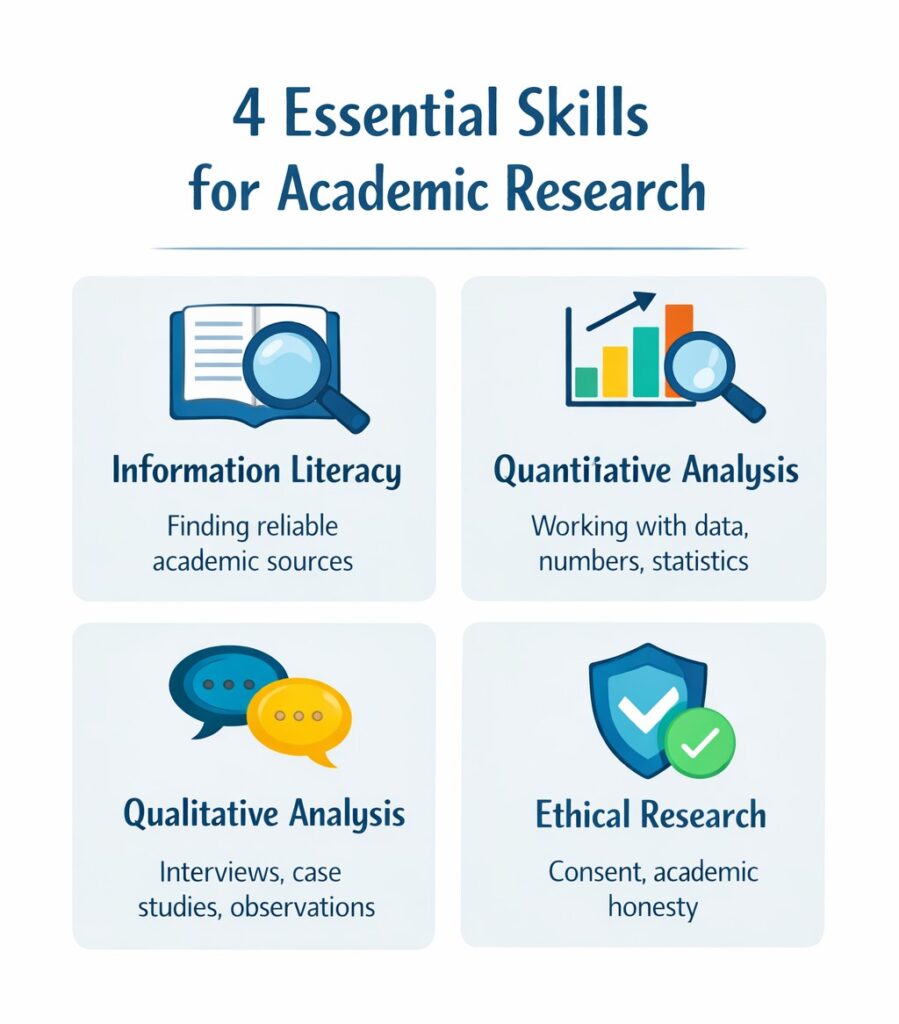
Before you start any project, it is vital that you have a firm grasp of what actually goes into academic research. Many people get caught out because they try to do research without really understanding what it entails. In order to have a robust academic track record, you should aim to master four key skills:
1) Information Literacy
This is knowing how to effectively locate, evaluate, and utilize information. With the advent of AI, it is more important than ever that you can tell the difference between academic journals and blogs.
2) Quantitative vs. Qualitative Analysis
You should decide what ‘language’ you will use for your research.
- Quantitative: Numbers, statistics, data – perfect for STEM or Economics-based courses.
- Qualitative: Interviews, case studies – great for courses like Sociology, History, Psychology.
3) Ethical Literacy
Having a robust academic track record requires academic ethics. If you will be working with people for your research (even something simple like surveys), you will need to have a grasp of informed consent.
Types of Research Work for High Schoolers
You don’t need a fancy, multi-million-dollar lab to create a foundation for yourself in research. Here are the most common types of research work for high schoolers:
1. Independent Research Project (The DIY Route)
Here, the journey begins by identifying a gap in what is known and conducting your own research. This might be as simple as studying the effects of noise pollution on the bird life in your area, or as complex as creating a new algorithm to predict the patterns in your city’s traffic.
2. The Literature Review
If you are more interested in theory than actual research, a Literature Review is a great place to start. This involves collecting existing research on a topic and using this to identify trends and new approaches, such as a “review of the reviews.”
3. Research Internships
Networking and becoming a research intern or trainee is a great way to brand yourself as a student. Even a simple data entry job or lab maintenance work for a professional research assistant can be a great experience and help you earn a stellar letter of recommendation.
4. Guided Mentorship Programs
There are a number of programs such as the Lumiere Research Scholar Program and the Horizon Academic Research Program that provide mentors at the PhD level to help you develop your paper and work towards publication.
Top Research Programs for Indian Students
If you are looking for a structured pathway for building your academic credentials, here are some of the top research programs for Indian students:
- Lumiere Research Scholar Program: A program that matches PhD mentors for high-level research papers.
- Young Scholars Program (Ashoka University): A program that introduces you to liberal arts research.
- IISER Pune RMP: A selective research mentorship program for science research.
- RISE Research: Aims to assist and guide you through publication and presentation of research papers.
How to Document Your Research Profile
It’s not enough to create your research profile; you also have to document it in your application.
An Academic Profile Example (Research Edition)
Instead of a bullet point on your resume, use the Problem-Action-Result method:
- Title: Lead Researcher, Urban Sociology Project
- The Problem: Noise pollution was high in the residential area of Chembur.
- The Action: Conducted a 3-month research project using decibel sensors and surveys.
- The Result: Wrote a 15-page paper; presented the research at a state science fair.
Where to Document Your Research Profile in Your Application:
- Common App Activities Section: If you’re targeting international universities, like in the US, list your research projects here.
- Supplemental Essays: Document your research project as an expression of your “intellectual vitality.”
- Additional Information: If you have a published paper, you can share the link here.
Final Thoughts
Your academic profile is your personal brand. You are living in a world that is becoming increasingly automated, but the ability to do original academic research is what makes you human. It’s what makes you uniquely qualified. Instead of going for the grade, be a scholar who wants to know why.
Having trouble deciding on a research topic that will help you reach your goals? Get a Personalized Profile Audit from Mindler and let’s turn your curiosity into a world-class application!
FAQs
1. Do I have to publish my research?
No, not at all. Passing peer review is great, but what matters most to admissions committees is the question you’re asking and the methods you’re using, not the credentials of the journal you’re publishing it in.
2. Can I do humanities research?
Absolutely. History, sociology, and literature are all great fields for research and are often useful for differentiation among STEM-focused applicants.
3. How do I balance my academic life and building my profile without burning out?
You can balance academics and profile building by combining research and academics. If you have an internal project or a term paper, consider making it a full research project over the summer.
4. What are some easy ways to improve my profile at school?
When you ask “ways to boost my CV in school?” The answer is by joining a research club, participating in a science fair (like INSEF), and taking an online course on research methods are all great options.