
One of the most important job choices you’ll make is what to study after high school. You might be thinking: Is a diploma better than a degree, since there are so many choices?
Both paths can lead to successful professions, but they have distinct goals. What you want to do with your life, how quickly you want to get a job, and what you want to do will all help you decide what to do.
Let’s understand the distinctions between a degree and a diploma, their pros and cons, and which one would be preferable for you after 12th grade.
What You Should Know About Diploma and Degree Courses
It’s crucial to know what each term signifies before you choose one.
What is a Degree?
A degree is a full academic qualification given by a university after a lengthier time of study, usually three to four years for undergraduates. Degree programs are meant to teach you a lot about a certain topic and provide you with research-based skills.
For instance, a Bachelor of Technology (B.Tech), Bachelor of Science (B.Sc), or Bachelor of Arts (B.A) degree can help you get a job or go to a higher level of school.
What is a Diploma?
A diploma course usually lasts one to three years and is more focused on teaching you skills rather than theory. Usually, Technical and Polytechnic colleges offer these programs for students seeking hands-on experience and job opportunities.
Some of the courses offered at these institutions include: a Diploma in Graphic Design, a Diploma in Hotel Management, or a Diploma in Engineering
Diploma vs Degree in India: Key Differences
So, what’s the difference between diploma and degree programs in India? Let’s compare them side by side for clarity.
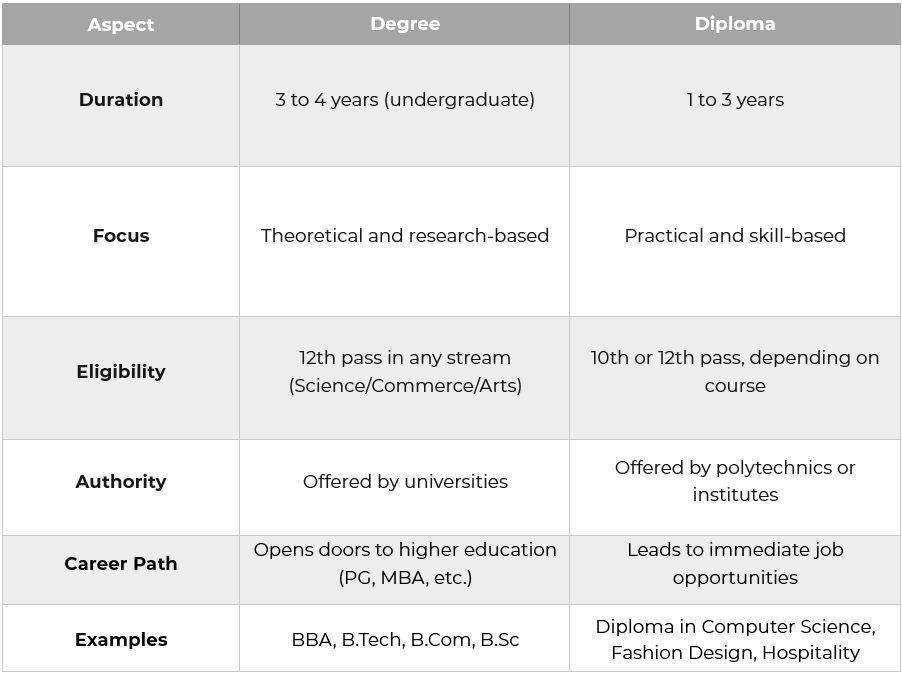
This table highlights the degree or diploma difference clearly. Degrees provide a broader academic foundation, while diplomas emphasize employable skills. A recent report says India’s overall graduate employability rate improved to 56.35% in 2026, up from 54.81% the previous year.
What You Should Know About Duration and Structure?
If you want to get a job quickly, a diploma can be beneficial for you because it takes less time to complete. Talking about certificate course vs diploma, most certificate programs can be finished in one to two years, whereas degree programs usually take three years or more.
But degrees usually cover more subjects and provide you the chance to study more after you finish your degree, which can help you move up faster in the long run.
So, when you think about a diploma vs degree, which is better, think about what’s most important to you: do you want to start working right away or spend more time getting a deeper education for long-term growth?
Job Prospects and Career Growth: Diploma vs. Degree in India
In India, both diplomas and degrees can help you find a good job, but the kind of work and compensation you can expect may be different.
People who have Diplomas
Diploma holders tend to be employed within technology, the arts or trades sectors where practical experience is very essential. For example:
- Individuals with an engineering degree are allowed to work as junior engineers or technicians.
- Individuals with a diploma in graphics design or multimedia may work in production or advertising firms.
- A nursing or hotel management diploma will allow you to work in the field of healthcare or in the hotel industry.
- A diploma would enable you to secure employment fast. However, in the absence of further education or experience, your job is not going to go much beyond that.
People who have Degrees
A degree often leads to better-paying and higher-level positions over time. Employers often prefer those with degrees for employment in management, research, or business.
For example:
- People who get a degree in engineering can become project managers or researchers.
- Many people who study business and management go on to work in business or finance.
- People who have degrees in the arts and humanities can work in the media, teaching, and public relations.
People with degrees can also get master’s degrees, like an MBA or M.Tech, which can help them make more money. According to the India Skills Report 2026, degree streams such as Computer Science and IT show employability above 78%, while polytechnic (diploma) streams have around 32.92% employability
Understanding All Your Options: Diploma vs Degree vs Certificate
You can also find certificate classes when you look for things to do after high school. These are even shorter programs that last a few weeks to a year and teach specific skills like graphic design, coding, or digital marketing.
Here’s the certificate, degree, diploma difference for you:
- Certificates are short and only cover one skill.
- Diplomas give you more training in a certain field of work.
- Degrees provide you a full academic and professional background in a field.
If you want to quickly learn the skills you need for a certain job, certifications or diplomas are wonderful options. But if you want to go up in your career, do research, or become a leader, a degree will help you in the long run.
Benefits of A Diploma
- Less Expensive: Diploma programs are frequently less expensive than degree programs.
- Practical Skills: The classes are hands-on and focused on getting a job.
- Admission is not strict: With some diplomas, you can enroll at 10 th grade, which means you can have them earlier.
Such aspects render diplomas convenient to students who desire to acquire a job right after or even those who desire to acquire a more advantageous job in the future through acquiring a part-time degree or an online degree.
Benefits of Having a Degree
- Better opportunities to advance in your career: Leadership and promotion jobs in large numbers require a degree.
- In order to attend graduate school, you must have a degree.
- More Money: A majority of individuals holding degrees earn more throughout their lifetime of their employment.
A degree is helpful for students who want to work for a long time, especially in disciplines like academics, technology, or management. In India, salary trends show that diploma holders typically start with an annual salary of around ₹2.2–₹4 lakh, whereas degree holders generally start between ₹3–₹6 lakh.
A Degree or A Diploma: Which is Better?
Which is better for your job: a degree or a diploma? What you want to do will determine what you do.
If you want to get a job right away, a diploma will help you get one faster and with more skills. It’s also great for creative or technical fields where real-world experience is more important than formal education.
If you want more job options, recognition around the world, and chances to go to college, though, a degree is the better choice.
Let’s say there are two students who don’t exist:
- Arjun got a job two years after finishing his Mechanical Engineering diploma.
- Meera got a B.Tech in the same field and graduated later, but she quickly moved on to doing research and managing projects at the graduate level.
They both made it, but they did it in different ways and at different times. This is the exact degree diploma difference: the choice you make affects how quickly and how far you go.
Conclusion
Your career aspirations will help you decide whether to get a diploma or a degree after 12th grade. A diploma can help you get a job early and learn by doing if you want to. But if you want to keep growing, getting a degree will provide you with a better base for more school and long-term success.
When you ask yourself whether a diploma is better than a degree, keep in mind that there is no one right answer. The ideal option should the one that matches with your goals, how you like to study, and what you see for your future self.
Your journey starts with figuring out what really works for you. So, choose only a top-tier career counselling after 10th or 12th, to make sure your future stays fruitful.
FAQs
1. Is degree and diploma the same thing?
No. A degree is a higher level of education, whereas a diploma is a shorter course that teaches skills.
2. What’s the difference between diploma and degree?
A degree teaches you about theory and research, whereas a certification teaches you how to do things in real life.
3. Is a diploma or a degree better?
A diploma is better for getting a job quickly, but a degree is better for long-term growth and going to school after college.
4. What about courses that give you a certificate?
Certificates are shorter and more focused than diplomas. Diplomas, on the other hand, give you more general training for a profession.
5. Is it possible for me to accomplish both?
Yes! Many students initially get a diploma to learn skills and then get a degree later to move on in their careers.