Artificial Intelligence (AI) is now shaping every major industry—from healthcare and engineering to marketing, design, and finance. As more organisations adopt automation and data-driven systems, students and young professionals must understand the artificial intelligence skills required to stay future-ready. The demand for AI talent continues to grow sharply, and being prepared early can help you build a stronger academic profile, better projects, and a more competitive CV for higher education and professional opportunities.
This guide explains the top ai skills in demand for 2026, how to develop them during school or college, and why building these competencies now gives you a strong advantage in admissions, internships, and early career choices.
Why AI Skills Matter in 2026
AI has expanded its presence worldwide and is used not only for tech roles but also outside the tech world. Today’s companies consider students who possess a basic knowledge of machine learning, data, and automation as a plus, no matter what career stream they belong to. Universities around the world now assess students on their digital readiness, and employers increasingly look for the skills required for artificial intelligence jobs even for entry-level roles.
To understand how AI careers work across streams, you can explore Mindler’s detailed guide on building a Career in Artificial Intelligence
Top AI Skills Every Student Should Build (2026 Edition)
Below are the most essential ai skills for the future, broken down in a student-friendly manner with clear steps to develop each.
1. Strong Foundations in Mathematics and Statistics
AI systems function by depending on logic, probability, optimisation, and numerical modelling as their main supporting pillars; thus, Mathematics is still the largest portion of most AI jobs’ skill lists.
Key Concepts to Build:
- Linear algebra
- Calculus (basics)
- Probability and statistics
- Optimisation models
Why it matters:
Mastering these concepts makes you capable of cutting-edge work in machine learning algorithms and data analysis, which are among the core skills needed for AI careers.
2. Programming Skills (Python, R, or Java)
Coding is considered to be one of the most important ai required skills since it permits the implementation of models and the automation of tasks while being able to handle the data.
Languages to focus on:
- Python (which is the most comprehensive language in the AI world)
- R (widely accepted in analytical data processing)
- Java or C++ (for massive applications)
How to move forward:
- Start with the Python fundamentals during your school or early college years.
- Practice coding on platforms like Kaggle and GitHub.
- Create very simple scripts, calculators, or basic data projects to enhance your understanding.
3. Data Handling and Analysis Skills
AI depends heavily on data. Students must understand how to collect, clean, and analyse data using modern tools.
What to learn:
- Data visualisation
- Data cleaning
- Working with CSV files or datasets
- Tools like Excel, Python’s Pandas library, or SQL
Why it matters:
Data literacy is now one of the most essential skills required for artificial intelligence because AI models perform well only when students can manage data effectively.
4. Machine Learning Fundamentals
Machine learning (ML) is the heart of AI. Even at a beginner level, students should understand how ML models work.
Topics to Explore:
- Supervised vs. unsupervised learning
- Decision trees
- Regression and classification
- Neural networks
- Training and testing datasets
How it helps:
The knowledge of ML not only supports your AI skills but also makes your resume more appealing, particularly if you are going to apply for internships, research programs, or college admissions with a strong STEM focus.
5. Critical Thinking and Analytical Skills
The AI sector is not solely for coders; it is also for students with strong analytical skills. Companies appreciate analytical thinking, as AI is the application of logic and creativity in solving real-world problems.
Some of the analytical tasks are as follows:
- Discovering patterns in data collections
- Assessing the correctness of the model
- Getting the gist of the effect of automation
- Dividing hard problems into minor parts and solving them one by one
6. Understanding AI Tools and Platforms
By the year 2026, it is predicted that students will be dealing with AI tools instead of just coding models from the very beginning. Knowing the mechanisms of the platforms makes one ready for the industry in a shorter period.
Common Tools to Learn:
- TensorFlow
- PyTorch
- Google Colab
- Tableau or Power BI
- LLM-based tools and prompt engineering basics
Why this matters:
Knowing these tools supports the skills required for artificial intelligence jobs, especially in roles related to automation, research, and data operations.
7. Communication and Collaboration Skills
In general, AI teams contain people from various areas such as design, business, research, and engineering. Communication of discoveries by students in a clear manner would be the first step in their success.
What this includes:
- Writing reports
- Presenting findings with visuals
- Collaborating with peers
- Explaining technical concepts simply
Good communication is now considered one of the top ai skills in demand for entry-level professionals.
8. Ethics, Digital Literacy, and Responsible AI Behaviour
AI raises important questions about privacy, fairness, and decision-making. Students must understand these concepts early to become responsible future professionals.
Ethics Topics to Learn:
- Bias in AI
- Data privacy
- Transparency
- Safe digital behaviour
This is increasingly a priority for universities and global employers.
9. Research Skills and Curiosity
AI is growing quickly. Students who stay updated with new models, tools, and techniques develop stronger ai skills for the future.
How to build this skill:
- Follow research-driven platforms
- Participate in online courses
- Read about new AI applications
- Engage in competitions such as hackathons
Research strengthens long-term learning and helps you stand out academically.
Which AI Skills Are Most in Demand?
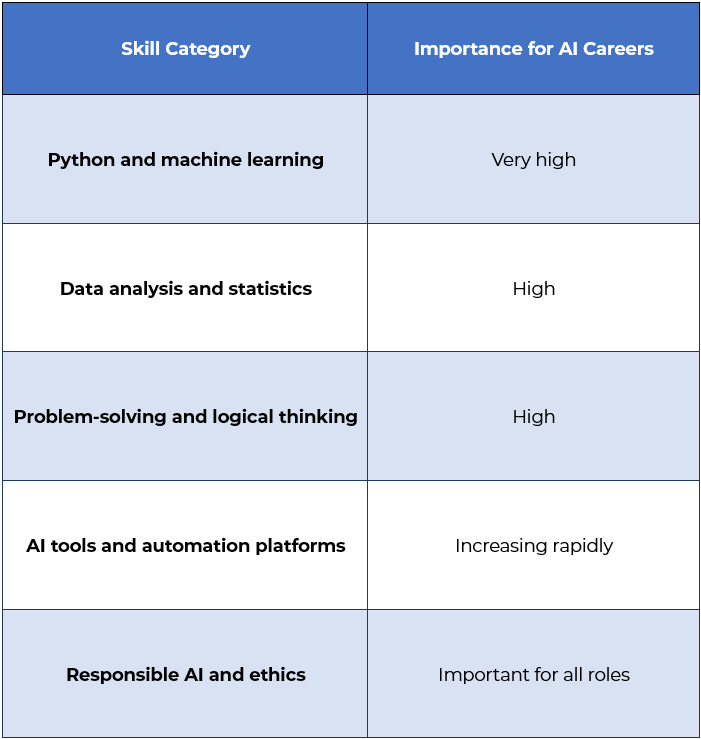
Interested to know which ai skills are most in demand in 2026? Here is a short table:
How Students Can Start Developing AI Skills Today
Today, students from different disciplines – science, commerce, and humanities – can all start to develop AI skills. For this, Mindler has published an in-depth Guide for Students of Classes 11 and 12 who are interested in AI Careers.
Moreover, you can consider enrolling in the AI Career Immersion Programme provided by Mindler, where you work on projects, earn certifications, and improve your abilities according to your own speed.
Conclusion
AI careers are on the rise in terms of diversity, accessibility and rewards. Students who acquire the necessary skills for AI, regardless of nature, get a big plus in the areas of university admissions, internships and career growth over the long term. Begin with experimenting with AI tools, creating small projects, understanding the basics and being a lifelong learner.
To enhance your professional development and acquire all the artificial intelligence skills required, consider Mindler’s structured AI learning pathway for your journey.
FAQs
1. Do I need to be a Science student to learn AI?
No. Students from Commerce or Humanities can also learn AI basics, especially analytical thinking, data skills, and ethical understanding.
2. Are coding skills compulsory for AI careers?
Coding helps, but many roles focus on research, data operations, ethics, design, or analysis—where coding is only partly required.
3. What are the easiest AI skills to start with?
Begin with Python basics, data interpretation, and learning how AI tools work.
4. Can school students build AI projects?
Yes. Students can create beginner-friendly ML models, use AI tools, or participate in competitions to build early exposure.