
Writing for the IELTS test requires accuracy in a very short amount of time and measures how well you can be clear, coherent, and comprehensive while writing under pressure. Task 1 requires you to report on some information within a 20-minute time period, and Task 2 will require you to write a structured, well-developed response to an essay from a given topic within a 40-minute timeframe. The two tasks evenly contribute towards your overall writing score for the IELTS test.
Starting out as an inexperienced writer, your goal will be to develop good planning skills, a strong foundation in grammar and lexical resources, and to have regular practice with your IELTS Writing skills. Many common writing tasks will require candidates to write from both sides of a question and statement with the use of appropriate words. However, one also needs to focus on the appropriate management of writing time in IELTS.
Use an IELTS Writing Checker and an Online Writing Evaluation Tool to improve your IELTS Writing Training Results. This document will cover all tips for the IELTS Writing Tasks 1 and 2.
Understanding IELTS Writing Structure
The IELTS Writing test is composed of 2 sections, which assess your writing ability through the use of several different methods. Each method will give you an individual test score for the IELTS writing test based on how well you meet all four assessment criteria.
Task 1 overview and time allocation
Task 1 of IELTS requires the candidate to describe a visual representation of information presented in various formats. The Vancouver test has a word limit of 150 words and requires the candidate to complete this section within 20 minutes.
Task 2 essay requirements
In Task 2 of IELTS, candidates are required to produce an essay on the following topics: Expressing opinion, Discussing views, and Presenting a Solution. The candidate’s essay must be at least 250 words long and must be produced in 40 minutes.
Band descriptors breakdown
To achieve a band score of 7 or higher, IELTS candidates must demonstrate logical organisation of their essays, use a variety of vocabulary, and produce complex sentence structures with accurate use of punctuation and grammar.
Common IELTS Writing Task Topics
There will likely be some themes that constantly recur; therefore, you can use the above set of topics to help you focus your IELTS writing to improve your chances of success. These are some recurring themes:
Pollution and the environment
Renewable energy vs urbanization effect Example prompt: “Governments should put more money into public transport to reduce emissions.”
Education & Technology Integration
Comparing online learning with traditional learning; Example prompt: “What are the benefits of having a digital classroom in the developing world?”
Health and lifestyle change
The rise of obesity and increasing mental health issues. Common prompt: “Fast food is a contributor to many health-related problems; do you agree or disagree?”
Impacts of globalisation
The homogenisation of culture; to adequately address an IELTS task 2 question regarding globalisation, you must provide examples of both views and critically evaluate them.
How to Prepare for IELTS Task 1
One of the primary tips for IELTS Writing Task 1 is to identify an overview of the writing task and the main points to consider when writing responses to the writing task under highly restrictive time limits in the IELTS examination.
Graph and Chart Description Techniques
You should begin by identifying overall tendencies: for example, “Increased steadily”, “Fluctuated”. When paraphrasing questions, change the word choice so that you can use the same words and phrases for your IELTS writing. Use “illustrates” instead of “shows.”
Process and Map Overview Techniques
Sequencing: “Initially” and “Subsequently”. On maps, highlight changes that have taken place; for example, “Has been converted to” will help you to achieve a Band 7+ in IELTS Writing.
Data Selection for High Bands
Select 3-4 key features to focus on; do not attempt to list all of the data and information pointwise. Timed IELTS Writing Practice will help you to achieve this and can help you to complete your response in the 20-minute time frame.
Avoiding Common Mistakes for IELTS Task 1
Avoid overly describing minor details; by practicing with an IELTS writing checker, you will likely be able to see common balance error issues with your writing.
IELTS Writing Task 2 Essay Mastery
In IELTS writing Task 2, evenly weighting all tasks indicates that the organization of the essay is more important than the amount of content produced.
Types And The Structure
- Opinion – Introduction, Position Statements, Argument, Ideas, and Conclusion.
- Discussion – Both points of view are presented with an overall opinion at the end.
- Problem-Solution – Issues/Problems identified with measures (solutions) taken/benefits of these solutions.
Essay Plan (Planning)
Plan the Essay in five minutes. Write down your ideas for Body Paragraphs in pairs and words you would use for each idea. This will save time in the forty minutes you have to complete the writing section.
Coherence and Cohesion Markers
Using markers such as ‘Additionally’, ‘In contrast’, etc, gives the reader an idea of how your ideas are connected.
Vocabulary and Grammar are used equally –
You will score higher in IELTS writing if you mix 60% common vocabulary with 40% academic vocabulary. You must use good Quality Sentences of varying degrees of complexity (error-free) to achieve at least Band 8 in IELTS writing.
Essential Vocabulary for IELTS –
Using strategic vocabulary to boost the quality of your IELTS Writing score without overwhelming yourself with vocabulary lists.
Essential Words to Use in IELTS Writing
Strategic vocabulary elevates IELTS writing score without memorisation overload.
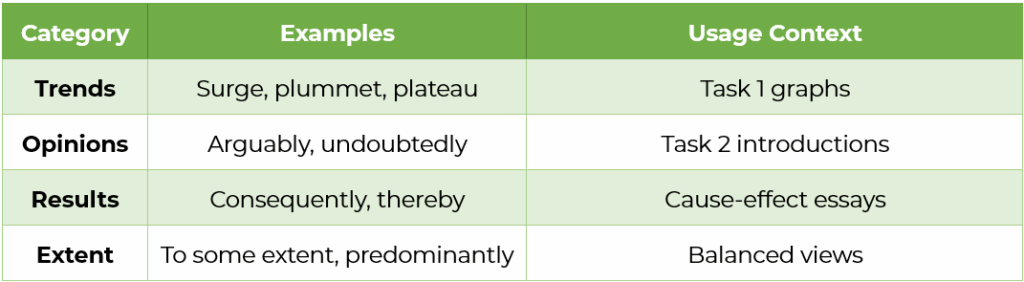
These words to use in IELTS writing appear naturally in high-scoring IELTS writing examples .
Writing Tips and Tricks for IELTS Band 7+
Beginner IELTS writing can experience fast improvements through focused practice.
Test Time Management
Task 1 – 3min to prepare, 15min to write, 2min to review. Task 2 – 5min to prepare, 30min to write, 5min to edit were the time frames for writing in this regard.
Complex Grammatically & Error Free
By using a mix of simple, compound & complex sentences; conditionals & passive voice; will give candidates a better IELTS writing score. Being too ambitious will cause errors.
Practice Writing Via IELTS Checker
Various online tools give candidates immediate online evaluation of IELTS writing based on Band 9; compare your work against Band 9 samples on a weekly/ monthly basis.
Daily Routine Practice IELTS Writing
Candidates should write one Task One & one Task Two per day; and use public band descriptors in order to continually assess their progress.
IELTS Writing Preparation Resources
By systematically completing the tasks in the different writing topics on each of the Cambridge IELTS 15-19 series, candidates can expect a systematic development of IELTS Writing skills towards achieving Band 7+
Official practice materials
Candidates are encouraged to study from official Cambridge IELTS books 15-19. These IELTS books contain authentic IELTS writing task topics and example writing tasks with both written and sample answers.
Online evaluation platforms
Online tools have been created that provide simulated online evaluations of candidates’ writing resources. The online writing tools are called Grammarly and IELTS Liz.
Structured training courses
Candidates have access to structured training courses for developing their writing skills. These training courses provide weekly feedback on Writing tasks, particularly with regard to developing poor or weak areas such as Task 1 (overviews) in writing.
IELTS Writing Tips for Beginners
For those just starting out with their IELTS Test preparation, here are some essentials to help keep your writing on track for consistent improvement moving from Band 5 upwards towards Band 7.
Basic Structure Templates
4 paragraph essays will provide a dependable template in which all of the parts that comprise an effective essay can be fulfilled: Introduction Paralogise, 2 Body Paragraphs, Conclusion – Restatement.
Vocabulary Development
Develop collocations related to topics of interest. These should be used immediately while you are practicing your IELTS writing.
Checklist For Avoiding Common Errors
Count all words for required length (150/250 minimum) and verify subject/verb agreement. After writing, always read through all written work and seek opportunities to avoid repeating the first word of every sentence.
For more assistance you can always consider opting for overseas academic counselling services at Mindler to proceed ahead with clarity.
Final Thoughts
To become proficient in IELTS Writing, consistent practice, strategic preparation, and utilizing feedback from an IELTS writing checker are all important components. Focusing on coherence, vocabulary range and time discipline will improve your overall writing score for both IELTS Writing Task 1 and IELTS Writing Task 2.
To improve your chances at obtaining band 7+, make sure to incorporate writing tips and tricks for IELTS as specified above, and seek out an IELTS writing online evaluation. Understanding the types of writing tasks you will face in exams through IELTS Writing examples and training will build your confidence while writing under the timed restrictions of IELTS.
Frequently Asked Questions
How can I improve my IELTS writing score quickly?
Practice daily with the IELTS Writing Task. Focus on the second part when doing this. Use a set of model essays for guidance.
What are the most frequent IELTS Task 2 subjects?
The most frequent IELTS Task 2 subjects are Education, The Environment and Technology & Crime. It is important to prepare both sides of each argument. Once the opinion piece is written, it is important to provide relevant language that relates to the topic.
How long is the IELTS Writing Task 1?
20 minutes and 150 words. Try to write the overview and key trends of the graph and only write a brief summary of the information.
What are some basic IELTS writing tips for band 9?
Use a template and write simple and complicated sentences. Do a practice test every day using the IELTS writing tasks. Include a section where you evaluate your writing.
Where can I get online evaluation for my IELTS Writing?
The official Cambridge website, IELTS Liz and many other online training websites that offer feedback on your writing.